


Page 142 - Encyclopedia of Aquarium and Pond Fish, 3rd Edition
P. 142
140    FRESHWATER FISH DIRECTORY


          Pterophyllum scalare
         Angelfish                                                                              Coloration is
                                                                    Semitransparent fins        brighter on
                                                                                                upperparts
           ORIGINS  South America, occurring through much of the
           Amazon basin, eastward from Peru to Belem, Brazil.
           SIZE  6 in (15 cm).
           DIET  Prepared foods, vegetable matter, small live foods.
           WATER  Temperature 75–82°F (24–28°C); soft
           (50–100 mg/l) and acidic (pH 6.5).
           TEMPERAMENT  Relatively peaceful, but territorial.     First band
                                                                  passes through
         This graceful cichlid is among the most popular          the eye
         of all tropical fish. Young Angelfish are sometimes
         recommended for community aquariums, but
         their long fins make easy targets for fin-nippers   Long, narrow
                                                             pelvic fins
         such as Tiger Barbs (see p.83). Furthermore,
         Angelfish will soon grow too large for the tank
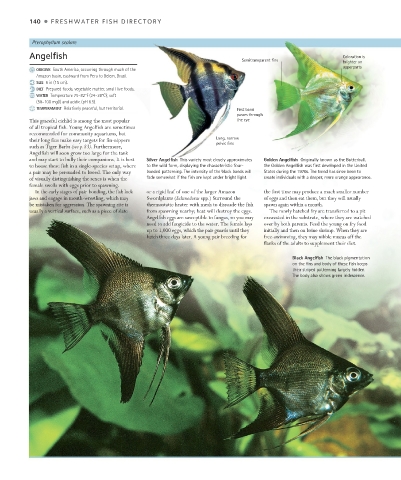
         and may start to bully their companions. It is best   Silver Angelfish  This variety most closely approximates   Golden Angelfish  Originally known as the Butterball,
         to house these fish in a single-species setup, where   to the wild form, displaying the characteristic four-   the Golden Angelfish was first developed in the United
         a pair may be persuaded to breed. The only way    banded patterning. The intensity of the black bands will   States during the 1970s. The trend has since been to
         of visually distinguishing the sexes is when the   fade somewhat if the fish are kept under bright light.  create individuals with a deeper, more orange appearance.
         female swells with eggs prior to spawning.
           In the early stages of pair-bonding, the fish lock   or a rigid leaf of one of the larger Amazon   the first time may produce a much smaller number
         jaws and engage in mouth-wrestling, which may    Swordplants (Echinodorus spp.) Surround the   of eggs and then eat them, but they will usually
         be mistaken for aggression. The spawning site is   thermostatic heater with mesh to dissuade the fish   spawn again within a month.
         usually a vertical surface, such as a piece of slate    from spawning nearby; heat will destroy the eggs.     The newly hatched fry are transferred to a pit
                                         Angelfish eggs are susceptible to fungus, so you may   excavated in the substrate, where they are watched
                                         need to add fungicide to the water. The female lays   over by both parents. Feed the young on fry food
                                         up to 1,000 eggs, which the pair guards until they   initially and then on brine shrimp. When they are
                                         hatch three days later. A young pair breeding for   free-swimming, they may nibble mucus off the
                                                                          flanks of the adults to supplement their diet.

                                                                                  Black Angelfish  The black pigmentation
                                                                                  on the fins and body of these fish keeps
                                                                                  their striped patterning largely hidden.
                                                                                  The body also shows green iridescence.


   US_140-141_Angelfish.indd   140                                                                   29/08/18   4:09 PM

