


Page 144 - Encyclopedia of Aquarium and Pond Fish, 3rd Edition
P. 144
142    FRESHWATER FISH DIRECTORY


          Symphysodon aequifasciatus

         Blue Discus                                            White fins                       Red eye
                                                                                                 color
           ORIGINS  South America, from Rio Putumayo in Peru
           eastward through the Amazon basin in Brazil.
           SIZE  8 in (20 cm).
           DIET  Discus foods and small live foods.
           WATER  Temperature 75–84°F (24–29°C); soft
           (50–100 mg/l) and acidic (pH 6.0).
           TEMPERAMENT  Quite placid and social.
         The Blue Discus, named after its disk body shape,
         has grown in popularity over recent years thanks to
         the wide range of color varieties available. Four
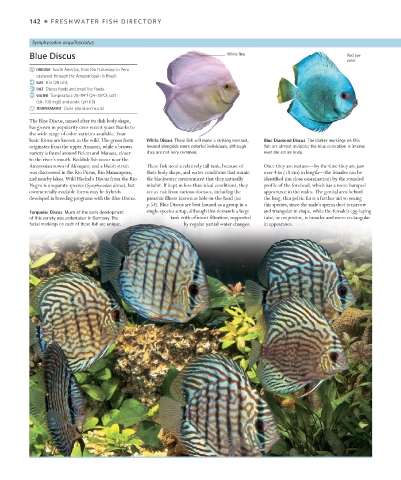
         basic forms are known in the wild. The green form   White Discus  These fish will make a striking contrast,   Blue Diamond Discus  The darker markings on this
         originates from the upper Amazon, while a brown   housed alongside more colorful individuals, although   fish are almost invisible; the blue coloration is intense
         variety is found around Belem and Manaus, closer    they are not very common.  over the entire body.
         to the river’s mouth. Reddish fish occur near the
         Amazonian town of Alenquer, and a bluish strain   These fish need a relatively tall tank, because of   Once they are mature—by the time they are just
         was discovered in the Rio Purus, Rio Manacapura,   their body shape, and water conditions that mimic   over 4 in (10 cm) in length—the females can be
         and nearby lakes. Wild Heckel’s Discus from the Rio   the blackwater environment that they naturally   identified (on close examination) by the rounded
         Negro is a separate species (Symphysodon discus), but   inhabit. If kept in less-than-ideal conditions, they   profile of the forehead, which has a more humped
         commercially available forms may be hybrids   are at risk from various diseases, including the   appearance in the males. The genital area behind
         developed in breeding programs with the Blue Discus.   parasitic illness known as hole-in-the-head (see    the long, thin pelvic fin is a further aid to sexing
                                         p.58). Blue Discus are best housed as a group in a   this species, since the male’s sperm duct is narrow
         Turquoise Discus  Much of the early development    single-species setup, although this demands a large   and triangular in shape, while the female’s egg-laying
         of this variety was undertaken in Germany. The    tank with efficient filtration, supported   tube, or ovipositor, is broader and more rectangular
         facial markings on each of these fish are unique.  by regular partial water changes.   in appearance.


   US_142-143_Discus.indd   142                                                                      29/08/18   4:09 PM

