


Page 145 - Encyclopedia of Aquarium and Pond Fish, 3rd Edition
P. 145
CICHLIDS/DISCUS     143


                                                                Blue and red
      Interlinking                                              fin coloring
      random lines                                                       Even depth
                                                                         of color


                                                                                                Faint traces
                                                                                                of banding
                                                                                                on the flanks
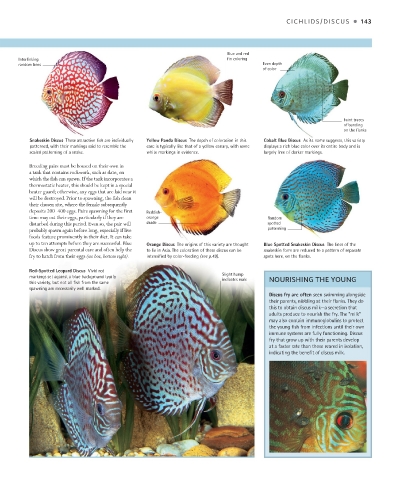
         Snakeskin Discus  These attractive fish are individually   Yellow Panda Discus  The depth of coloration in this   Cobalt Blue Discus  As its name suggests, this variety
         patterned, with their markings said to resemble the   case is typically like that of a yellow canary, with some   displays a rich blue color over its entire body and is
         scaled patterning of a snake.   white markings in evidence.      largely free of darker markings.
         Breeding pairs must be housed on their own in
         a tank that contains rockwork, such as slate, on
         which the fish can spawn. If the tank incorporates a
         thermostatic heater, this should be kept in a special
         heater guard; otherwise, any eggs that are laid near it
         will be destroyed. Prior to spawning, the fish clean
         their chosen site, where the female subsequently
         deposits 200–400 eggs. Pairs spawning for the first   Reddish-
         time may eat their eggs, particularly if they are   orange        Random
         disturbed during this period. Even so, the pair will   shade      spotted
         probably spawn again before long, especially if live              patterning
         foods feature prominently in their diet. It can take
         up to ten attempts before they are successful. Blue   Orange Discus  The origins of this variety are thought    Blue Spotted Snakeskin Discus  The lines of the
         Discus show great parental care and often help the   to lie in Asia. The coloration of these discus can be   snakeskin form are reduced to a pattern of separate
         fry to hatch from their eggs (see box, bottom right).  intensified by color-feeding (see p.49).  spots here, on the flanks.
         Red-Spotted Leopard Discus  Vivid red                Slight hump
         markings set against a blue background typify        indicates male  NOURISHING THE YOUNG
         this variety, but not all fish from the same
         spawning are necessarily well marked.
                                                                           Discus fry are often seen swimming alongside
                                                                           their parents, nibbling at their flanks. They do
                                                                           this to obtain discus milk —a secretion that
                                                                           adults produce to nourish the fry. The “milk”
                                                                           may also contain immunoglobulins to protect
                                                                           the young fish from infections until their own
                                                                           immune systems are fully functioning. Discus
                                                                           fry that grow up with their parents develop
                                                                           at a faster rate than those reared in isolation,
                                                                           indicating the benefit of discus milk.


   US_142-143_Discus.indd   143                                                                      29/08/18   4:09 PM

