


Page 146 - Encyclopedia of Aquarium and Pond Fish, 3rd Edition
P. 146
144    FRESHWATER FISH DIRECTORY


          Dicrossus filamentosus          Nannacara anomala               Apistogramma borellii
         Chessboard Cichlid              Golden Dwarf Cichlid             Umbrella Dwarf Cichlid

           ORIGINS  South America, in the Rio Orinoco basin in   ORIGINS  Widely distributed throughout northern parts   ORIGINS  South America, found in parts of the Mato
           Colombia and the Rio Negro basin in Brazil.   of South America.  Grosso, Brazil, and the Pantanal, Paraguay.
              1
           SIZE  3 ⁄2 in (9 cm).           SIZE  3 in (7.5 cm).             SIZE  3 in (7.5 cm).
           DIET  Live foods and prepared foods.  DIET  Prepared foods and small live foods.  DIET  Prepared foods and small live foods
           WATER  Temperature 73–77°F (23–25°C); soft    WATER  Temperature 73–82°F (23–28°C); soft    WATER  Temperature 72–77°F (22–25°C); soft
           (50–100 mg/l) and acidic (pH 6.0).  (50–100 mg/l) and acidic (pH 6.0).  (50–100 mg/l) and acidic (pH 6.0).
           TEMPERAMENT  Relatively peaceful.  TEMPERAMENT  Peaceful and social.  TEMPERAMENT  Males are territorial.
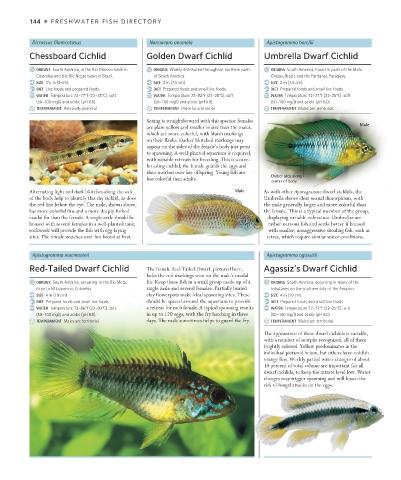
                                         Sexing is straightforward with this species: females
                                         are plain yellow and smaller in size than the males,       Male
                                         which are more colorful, with bluish markings
                                         on their flanks. Darker blotched markings may
                                         appear on the sides of the female’s body just prior
                                         to spawning. A well-planted aquarium is required,
                                         with suitable retreats for breeding. This is a cave-
                                         breeding cichlid; the female guards the eggs and
                                         then watches over her offspring. Young fish are
                                         less colorful than adults.         Darker area along
                                                                            center of body
         Alternating light and dark blotches along the side       Male    As with other Apistogramma dwarf cichlids, the
         of the body help to identify this shy cichlid, as does           Umbrella shows clear sexual dimorphism, with
         the red line below the eye. The male, shown above,               the male generally larger and more colorful than
         has more colorful fins and a more deeply forked                  the female. This is a typical member of the group,
         caudal fin than the female. A single male should be               displaying variable coloration. Umbrellas are
         housed with several females in a well-planted tank;               rather nervous fish and settle better if housed
         rockwork will provide the fish with egg-laying                    with smaller, nonaggressive shoaling fish, such as
         sites. The female watches over her brood at first.                tetras, which require similar water conditions.

          Apistogramma macmasteri                                         Apistogramma agassizii
         Red-Tailed Dwarf Cichlid        The female Red-Tailed Dwarf, pictured here,   Agassiz’s Dwarf Cichlid
                                         lacks the red markings seen on the male’s caudal
           ORIGINS  South America, occurring in the Rio Meta,    fin. Keep these fish in a small group made up of a   ORIGINS  South America, occurring in many of the
           close to Villavicencio, Colombia.  single male and several females. Partially buried   tributaries on the southern side of the Amazon.
           SIZE  4 in (10 cm).           clay flowerpots make ideal spawning sites. These   SIZE  4 in (10 cm).
           DIET  Prepared foods and small live foods.  should be spaced around the aquarium to provide   DIET  Prepared foods and small live foods.
           WATER  Temperature 73–86°F (23–30°C); soft    a retreat for each female. A typical spawning results   WATER  Temperature 72–77°F (22–25°C); soft
           (50–100 mg/l) and acidic (pH 6.0).   in up to 120 eggs, with the fry hatching in three   (50–100 mg/l) and acidic (pH 6.0).
           TEMPERAMENT  Males are territorial.  days. The male sometimes helps to guard the fry.  TEMPERAMENT  Males are territorial.
                                                                          The appearance of these dwarf cichlids is variable,
                                                                          with a number of morphs recognized, all of them
                                                                          brightly colored. Yellow predominates in the
                                                                          individual pictured below, but others have reddish-
                                                                          orange fins. Weekly partial water changes of about
                                                                          10 percent of total volume are important for all
                                                                          dwarf cichlids, to keep the nitrate level low. Water
                                                                          changes may trigger spawning and will lessen the
                                                                          risk of fungal attacks on the eggs.


   US_144-145_Dwarf_Cichlids.indd   144                                                              29/08/18   4:09 PM

