


Page 156 - Encyclopedia of Aquarium and Pond Fish, 3rd Edition
P. 156
154    FRESHWATER FISH DIRECTORY


          Tropheus moorii
         Moorii                          Yellow-Banded
                                         Moorii  It is not
           ORIGINS  East Africa, restricted to Lake Tanganyika,   possible to rely on
           where it occurs in the southern part of the lake.   the coloration of
           SIZE  6 in (15 cm).           these Moorii to
                                         determine the sexes,
           DIET  Cichlid diets and vegetable matter, including algae.
           WATER  Temperature 72–81°F (22–27°C); hard   because the banded
                                         patterning is
           (150–200 mg/l) and alkaline (pH 7.5–8.0).  very variable.
           TEMPERAMENT  Somewhat territorial.


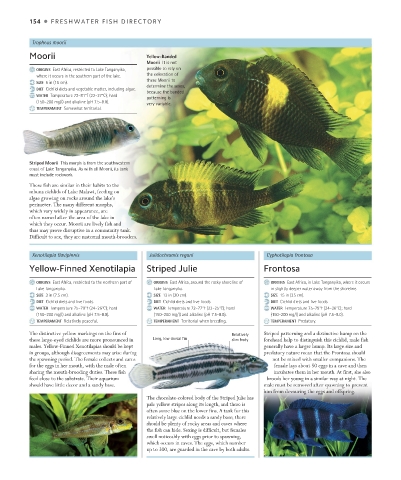
         Striped Moorii  This morph is from the southwestern
         coast of Lake Tanganyika. As with all Moorii, its tank
         must include rockwork.
         These fish are similar in their habits to the
         mbuna cichlids of Lake Malawi, feeding on
         algae growing on rocks around the lake’s
         perimeter. The many different morphs,
         which vary widely in appearance, are
         often named after the area of the lake in
         which they occur. Moorii are lively fish and
         thus may prove disruptive in a community tank.
         Difficult to sex, they are maternal mouth-brooders.

          Xenotilapia flavipinnis         Julidochromis regani            Cyphotilapia frontosa
         Yellow-Finned Xenotilapia       Striped Julie                    Frontosa

           ORIGINS  East Africa, restricted to the northern part of   ORIGINS  East Africa, around the rocky shoreline of    ORIGINS  East Africa, in Lake Tanganyika, where it occurs
           Lake Tanganyika.                Lake Tanganyika.                 in slightly deeper water away from the shoreline.
           SIZE  3 in (7.5 cm).            SIZE  12 in (30 cm).             SIZE  15 in (35 cm).
           DIET  Cichlid diets and live foods.  DIET  Cichlid diets and live foods.  DIET  Cichlid diets and live foods.
           WATER  Temperature 75–79°F (24–26°C); hard    WATER  Temperature 72–77°F (22–25°C); hard    WATER  Temperature 75–79°F (24–26°C); hard
           (150–200 mg/l) and alkaline (pH 7.5–8.0).  (150–200 mg/l) and alkaline (pH 7.5–8.0).  (150–200 mg/l) and alkaline (pH 7.5–8.0).
           TEMPERAMENT  Relatively peaceful.  TEMPERAMENT  Territorial when breeding.  TEMPERAMENT  Predatory.
         The distinctive yellow markings on the fins of          Relatively   Striped patterning and a distinctive hump on the
         these large-eyed cichlids are more pronounced in   Long, low dorsal fin  slim body  forehead help to distinguish this cichlid, male fish
         males. Yellow-Finned Xenotilapias should be kept                 generally have a larger hump. Its large size and
         in groups, although disagreements may arise during               predatory nature mean that the Frontosa should
         the spawning period. The female collects and cares                 not be mixed with smaller companions. The
         for the eggs in her mouth, with the male often                      female lays about 50 eggs in a cave and then
         sharing the mouth-brooding duties. These fish                       incubates them in her mouth. At first, she also
         feed close to the substrate. Their aquarium                       broods her young in a similar way at night. The
         should have little decor and a sandy base.                       male must be removed after spawning to prevent
                                                                          him from devouring the eggs and offspring.
                                         The chocolate-colored body of the Striped Julie has
                                         pale yellow stripes along its length, and there is
                                         often some blue on the lower fins. A tank for this
                                         relatively large cichlid needs a sandy base; there
                                         should be plenty of rocky areas and caves where
                                         the fish can hide. Sexing is difficult, but females
                                         swell noticeably with eggs prior to spawning,
                                         which occurs in caves. The eggs, which number
                                         up to 300, are guarded in the cave by both adults.


   US_154-155_Lak_Tang_Vic.indd   154                                                                29/08/18   4:09 PM

