


Page 85 - Encyclopedia of Aquarium and Pond Fish, 3rd Edition
P. 85
CYPRINIDS/BARBS     83


          Pethia ticto                    Puntigrus tetrazona
         Tic-Tac-Toe Barb                Tiger Barb                                             No black
                                                                                                pigmentation
           ORIGINS  Asia, occurring from southern India to the   ORIGINS  Asia, in Sumatra and elsewhere in Indonesia;
           Himalayas; also in Sri Lanka.   also in Borneo and possibly Thailand.
                                               3
           SIZE  4 in (10 cm).             SIZE  2 ⁄4 in (7 cm).
           DIET  Prepared foods and live foods.  DIET  Prepared foods and live foods.
           WATER  Temperature 57–79°F (14–26°C); hard   WATER  Temperature 68–79°F (20–26°C); soft
           (100–150 mg/l) and around neutral (pH 7.0).  (50–100 mg/l) and slightly acidic (pH 6.5).
           TEMPERAMENT  Peaceful and social.  TEMPERAMENT  Social, sometimes aggressive.  Banding absent
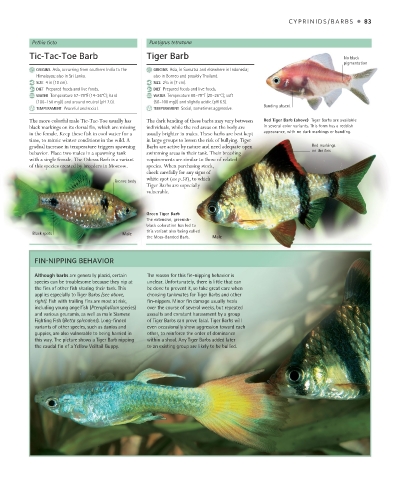
         The more colorful male Tic-Tac-Toe usually has   The dark banding of these barbs may vary between   Red Tiger Barb (above)  Tiger Barbs are available
         black markings on its dorsal fin, which are missing   individuals, while the red areas on the body are   in several color variants. This form has a reddish
         in the female. Keep these fish in cool water for a   usually brighter in males. These barbs are best kept   appearance, with no dark markings or banding.
         time, to mimic winter conditions in the wild. A   in large groups to lessen the risk of bullying. Tiger
         gradual increase in temperature triggers spawning   Barbs are active by nature and need adequate open   Red markings
         behavior. Place two males in a spawning tank   swimming areas in their tank. Their breeding   on the fins
         with a single female. The Odessa Barb is a variant   requirements are similar to those of related
         of this species created by breeders in Moscow.  species. When purchasing stock,
                                         check carefully for any signs of
                                         white spot (see p.58), to which
                                 Bronze body
                                         Tiger Barbs are especially
                                         vulnerable.

                                         Green Tiger Barb
                                         The extensive, greenish-
                                         black coloration has led to
          Black spots              Male  this variant also being called
                                         the Moss-Banded Barb.  Male

           FIN-NIPPING BEHAVIOR

           Although barbs are generally placid, certain   The reason for this fin-nipping behavior is
           species can be troublesome because they nip at   unclear. Unfortunately, there is little that can
           the fins of other fish sharing their tank. This   be done to prevent it, so take great care when
           applies especially to Tiger Barbs (see above,   choosing tankmates for Tiger Barbs and other
           right). Fish with trailing fins are most at risk,   fin-nippers. Minor fin damage usually heals
           including young angelfish (Pterophyllum species)   over the course of several weeks, but repeated
           and various gouramis, as well as male Siamese   assaults and constant harassment by a group
           Fighting Fish (Betta splendens). Long-finned   of Tiger Barbs can prove fatal. Tiger Barbs will
           variants of other species, such as danios and   even occasionally show aggression toward each
           guppies, are also vulnerable to being harried in   other, to reinforce the order of dominance
           this way. The picture shows a Tiger Barb nipping   within a shoal. Any Tiger Barbs added later
           the caudal fin of a Yellow Veiltail Guppy.   to an existing group are likely to be bullied.


   US_082-083_Barbs1.indd   83                                                                       29/08/18   4:09 PM

