


Page 92 - Encyclopedia of Aquarium and Pond Fish, 3rd Edition
P. 92
90    FRESHWATER FISH DIRECTORY


          Copella nigrofasciata           Corynopoma riisei               Copella arnoldi
         Black-Banded Pyrrhulina         Swordtail Characin               Splashing Tetra

           ORIGINS  Eastern South America, found in Brazil in the   ORIGINS  Found in northern South America, where it   ORIGINS  South America, occurring in Guyana, in the
           vicinity of Rio de Janeiro.     occurs in Colombia’s Rio Meta.   lower part of the Amazon basin.
                                                                               1
                                               1
           SIZE  2 ⁄2 in (6 cm).           SIZE  2 ⁄2 in (6.5 cm).          SIZE   3 ⁄4 in (8 cm).
              1
           DIET  Flake and small live foods.  DIET  Prepared foods and small live foods.  DIET  Prepared foods and small live foods.
           WATER  Temperature 70–77°F (21–25°C); soft   WATER  Temperature 72–82°F (22–28°C); soft   WATER  Temperature 77–84°F (25–29°C); soft
           (50–100 mg/l) and acidic (pH 6.0).  (50–100 mg/l) and neutral (pH 7.0).  (50–100 mg/l) and acidic (pH 6.0).
           TEMPERAMENT  Peaceful.          TEMPERAMENT  Peaceful and social.  TEMPERAMENT  Peaceful and social.
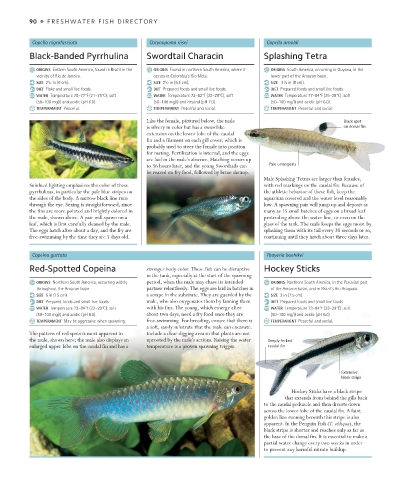
                                         Like the female, pictured below, the male              Black spot
                                         is silvery in color but has a swordlike                on dorsal fin
                                         extension on the lower lobe of the caudal
                                         fin and a filament on each gill cover, which is
                                         probably used to steer the female into position
                                         for mating. Fertilization is internal, and the eggs
                                         are laid in the male’s absence. Hatching occurs up
                                         to 36 hours later, and the young Swordtails can    Pale underparts
                                         be reared on fry food, followed by brine shrimp.
                                                                          Male Splashing Tetras are larger than females,
         Subdued lighting emphasizes the color of these                   with red markings on the caudal fin. Because of
         pyrrhulinas, in particular the pale blue stripes on              the athletic behavior of these fish, keep the
         the sides of the body. A narrow black line runs                  aquarium covered and the water level reasonably
         through the eye. Sexing is straightforward, since                low. A spawning pair will jump up and deposit as
         the fins are more pointed and brightly colored in                many as 15 small batches of eggs on a broad leaf
         the male, shown above. A pair will spawn on a                    protruding above the water line, or even on the
         leaf, which is first carefully cleaned by the male.              glass of the tank. The male keeps the eggs moist by
         The eggs hatch after about a day, and the fry are                splashing them with its tail every 30 seconds or so,
         free-swimming by the time they are 5 days old.                   continuing until they hatch about three days later.

          Copeina guttata                                                 Thayeria boehlkei
         Red-Spotted Copeina             stronger body color. These fish can be disruptive    Hockey Sticks
                                         in the tank, especially at the start of the spawning
           ORIGINS  Northern South America, occurring widely   period, when the male may chase its intended   ORIGINS  Northern South America, in the Peruvian part
           throughout the Amazon basin.  partner relentlessly. The eggs are laid in batches in   of the Amazon basin, and in Brazil’s Rio Araguaia.
           SIZE  6 in (15 cm).           a scrape in the substrate. They are guarded by the   SIZE  3 in (7.5 cm).
           DIET  Prepared foods and small live foods.  male, who also oxygenates them by fanning them   DIET  Prepared foods and small live foods.
           WATER  Temperature 73–84°F (23–29°C); soft   with his fins. The young, which emerge after   WATER  Temperature 73–84°F (23–29°C); soft
           (50–100 mg/l) and acidic (pH 6.0).  about two days, need a fry food once they are   (50–100 mg/l) and acidic (pH 6.0).
           TEMPERAMENT  May be aggressive when spawning.  free-swimming. For breeding, ensure that there is   TEMPERAMENT  Peaceful and social.
                                         a soft, sandy substrate that the male can excavate.
         The pattern of red spots is most apparent in    Include a clear digging area so that plants are not
         the male, shown here; the male also displays an   uprooted by the male’s actions. Raising the water   Deeply forked
         enlarged upper lobe on the caudal fin and has a   temperature is a proven spawning trigger.  caudal fin


                                                                                               Extensive
                                                                                               black stripe
                                                                                 Hockey Sticks have a black stripe
                                                                                that extends from behind the gills back
                                                                          to the caudal peduncle and then diverts down
                                                                          across the lower lobe of the caudal fin. A faint
                                                                          golden line running beneath this stripe is also
                                                                          apparent. In the Penguin Fish (T. obliqua), the
                                                                          black stripe is shorter and reaches only as far as
                                                                          the base of the dorsal fin. It is essential to make a
                                                                          partial water change every two weeks in order
                                                                          to prevent any harmful nitrate buildup.


   US_090-091_Characins.indd   90                                                                    29/08/18   4:09 PM

