


Page 88 - Encyclopedia of Aquarium and Pond Fish, 3rd Edition
P. 88
86    FRESHWATER FISH DIRECTORY


          Barbodes lateristriga           Desmopuntius rhomboocellatus    Hypsibarbus wetmorei
         T-Barb                          Round-Banded Barb                Pale Barb

           ORIGINS  Southeast Asia, from Thailand across the   ORIGINS  Asia, where it is thought to be restricted to the   ORIGINS  Southeast Asia, where its distribution is
           Malay Peninsula to Sumatra, Java, and Borneo.   island of Borneo.  restricted to Thailand.
           SIZE  7 in (18 cm).             SIZE  2 in (5 cm).               SIZE  7 in (18 cm).
           DIET  Prepared foods and live foods.  DIET  Prepared foods and live foods.  DIET  Prepared foods and live foods.
           WATER  Temperature 72–79°F (22–26°C); soft   WATER  Temperature 73–82°F (23–28°C); soft   WATER  Temperature 72–79°F (22–26°C); hard
           (50–100 mg/l) and acidic to neutral (pH 6.5–7.0).   (50–100 mg/l) and acidic (pH 6.5).   (100–150 mg/l) and neutral (pH 7.0).
           TEMPERAMENT  Peaceful and social.  TEMPERAMENT  Peaceful and social.  TEMPERAMENT  Peaceful and social.
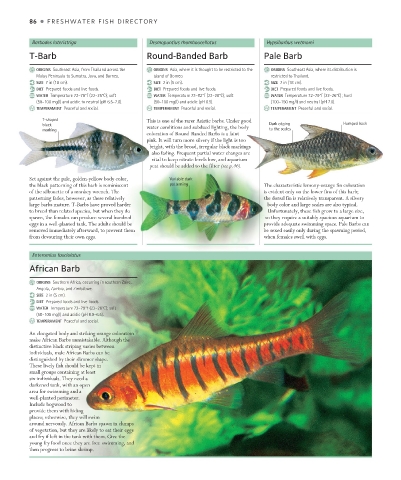
             T-shaped                    This is one of the rarer Asiatic barbs. Under good
             black                       water conditions and subdued lighting, the body   Dark edging   Humped back
             marking                                                       to the scales
                                         coloration of Round-Banded Barbs is a faint
                                         pink. It will turn more silvery if the light is too
                                          bright, with the broad, irregular black markings
                                           also fading. Frequent partial water changes are
                                           vital to keep nitrate levels low, and aquarium
                                          peat should be added to the filter (see p.46).
         Set against the pale, golden-yellow body color,    Variable dark
         the black patterning of this barb is reminiscent    patterning   The characteristic lemony-orange fin coloration
         of the silhouette of a monkey wrench. The                        is evident only on the lower fins of this barb;
         patterning fades, however, as these relatively                   the dorsal fin is relatively transparent. A silvery
         large barbs mature. T-Barbs have proved harder                    body color and large scales are also typical.
         to breed than related species, but when they do                   Unfortunately, these fish grow to a large size,
         spawn, the females can produce several hundred                   so they require a suitably spacious aquarium to
         eggs in a well-planted tank. The adults should be                provide adequate swimming space. Pale Barbs can
         removed immediately afterward, to prevent them                   be sexed easily only during the spawning period,
         from devouring their own eggs.                                   when females swell with eggs.

          Enteromius fasciolatus
         African Barb

           ORIGINS  Southern Africa, occurring in southern Zaire,
           Angola, Zambia, and Zimbabwe.
           SIZE  2 in (5 cm).
           DIET  Prepared foods and live foods.
           WATER  Temperature 73–79°F (23–26°C); soft
           (50–100 mg/l) and acidic (pH 6.0–6.5).
           TEMPERAMENT  Peaceful and social.
         An elongated body and striking orange coloration
         make African Barbs unmistakable. Although the
         distinctive black striping varies between
         individuals, male African Barbs can be
         distinguished by their slimmer shape.
         These lively fish should be kept in
         small groups containing at least
         six individuals. They need a
         darkened tank, with an open
         area for swimming and a
         well-planted perimeter.
         Include bogwood to
         provide them with hiding
         places; otherwise, they will swim
         around nervously. African Barbs spawn in clumps
         of vegetation, but they are likely to eat their eggs
         and fry if left in the tank with them. Give the
         young fry food once they are free-swimming, and
         then progress to brine shrimp.


   US_086-087_Barbs3.indd   86                                                                       29/08/18   4:09 PM

