


Page 87 - Encyclopedia of Aquarium and Pond Fish, 3rd Edition
P. 87
CYPRINIDS/BARBS     85


          Barbonymus schwanenfeldii       Dawkinsia arulius               Pethia gelius
         Tinfoil Barb                    Arulius Barb                     Golden Barb

           ORIGINS  Southeast Asia, from Thailand and the Malay   ORIGINS  Asia, restricted to southern and southeastern   ORIGINS  Asia, where it has been recorded in the central,
           Peninsula to Sumatra and Borneo.  parts of India.                eastern, and northeastern parts of India.
           SIZE  14 in (35 cm).            SIZE  4 ⁄4 in (12 cm).           SIZE  1 ⁄2 in (4 cm).
                                               1
                                                                               1
           DIET  Flake and live foods, some plant matter.  DIET  Flake and live foods, some plant matter.  DIET  Flake and small live foods, some plant matter.
           WATER  Temperature 72–77°F (22–25°C); soft (50 mg/l)   WATER  Temperature 66–77°F (19–25°C); soft (50 mg/l)   WATER  Temperature 64–72°F (18–22°C); soft (50 mg/l)
           and acidic (pH 6.0–6.5).        and acidic (pH 6.0–6.5).         and acidic to neutral (pH 6.5–7.0).
           TEMPERAMENT  Agreeable with fish of a similar size.  TEMPERAMENT  Peaceful and social.  TEMPERAMENT  Peaceful.
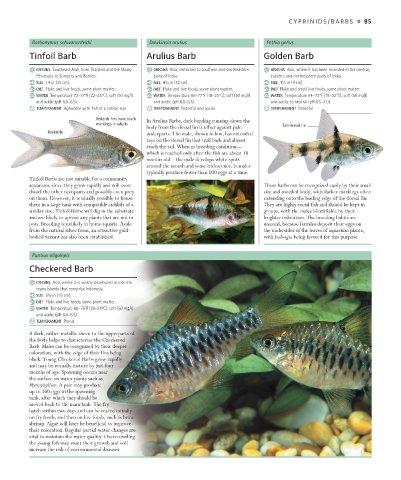
                           Reddish fins have black   In Arulius Barbs, dark banding running down the
                           markings in adults                                  Tall dorsal fin
                                         body from the dorsal fin is offset against pale
              Juvenile                   underparts. The male, shown below, has extended
                                         rays on the dorsal fin that trail back and almost
                                         reach the tail. When in breeding condition—
                                         which is reached only after the fish are about 18
                                         months old—the male develops white spots
                                         around the mouth and some iridescence. Females
                                         typically produce fewer than 100 eggs at a time.
         Tinfoil Barbs are not suitable for a community
         aquarium, since they grow rapidly and will soon                  These barbs can be recognized easily by their small
         dwarf the other occupants and possibly even prey                 size and mottled body, with darker markings often
         on them. However, it is usually possible to house                extending onto the leading edge of the dorsal fin.
         them in a large tank with compatible cichlids of a               They are highly social fish and should be kept in
         similar size. Tinfoil Barbs will dig in the substrate            groups, with the males identifiable by their
         and are likely to uproot any plants that are not in              brighter coloration. The breeding habits are
         pots. Breeding is unlikely in home aquaria. Aside                unusual, because females deposit their eggs on
         from the natural silver form, an attractive gold-                the undersides of the leaves of aquarium plants,
         bodied variant has also been established.                        with Ludwigia being favored for this purpose.

          Puntius oligolepis
         Checkered Barb

           ORIGINS  Asia, where it is widely distributed across the
           many islands that comprise Indonesia.
           SIZE  5 ⁄4 in (15 cm).
              3
           DIET  Flake and live foods, some plant matter.
           WATER  Temperature 68–75°F (20–24°C); soft (50 mg/l)
           and acidic (pH 6.0–6.5).
           TEMPERAMENT  Placid.
         A dark, rather metallic sheen to the upperparts of
         the body helps to characterize the Checkered
         Barb. Males can be recognized by their deeper
         coloration, with the edge of their fins being
         black. Young Checkered Barbs grow rapidly
         and may be sexually mature by just four
         months of age. Spawning occurs near
         the surface on water plants such as
         Myriophyllum. A pair may produce
         up to 300 eggs in the spawning
         tank, after which they should be
         moved back to the main tank. The fry
         hatch within two days and can be reared initially
         on fry foods, and then on live foods, such as brine
         shrimp. Algae will later be beneficial to improve
         their coloration. Regular partial water changes are
         vital to maintain the water quality. Overcrowding
         the young fish may stunt their growth and will
         increase the risk of environmental diseases.


   US_084-085_Barbs2.indd   85                                                                      14/09/18   12:07 PM

