


Page 90 - Encyclopedia of Aquarium and Pond Fish, 3rd Edition
P. 90
88    FRESHWATER FISH DIRECTORY

         CHARACOIDS


         It is surprisingly difficult to describe exactly what
         defines a characoid, in spite of the fact that
         many of them are popular aquarium fish.
         While they usually have teeth, they are not
         the only group of fish with this characteristic.
         Most characoids have a small, remote fin located
         on the back, just in front of the caudal fin. This fin,
         which lacks any rays, is called an adipose fin, but then
         again, not every member of the group displays this
         feature. Although the majority of characoid species
         are of New World origin, the group is also
         well represented in Africa.

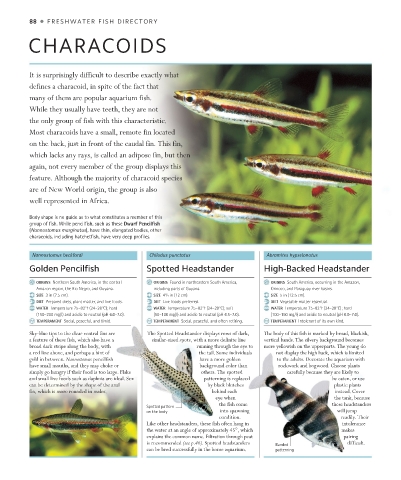
         Body shape is no guide as to what constitutes a member of this
         group of fish. While pencilfish, such as these Dwarf Pencilfish
         (Nannostomus marginatus), have thin, elongated bodies, other
         characoids, including hatchetfish, have very deep profiles.

          Nannostomus beckfordi           Chilodus punctatus              Abramites hypselonotus
         Golden Pencilfish               Spotted Headstander              High-Backed Headstander

           ORIGINS  Northern South America, in the central   ORIGINS  Found in northeastern South America,   ORIGINS  South America, occurring in the Amazon,
           Amazon region, the Rio Negro, and Guyana.  including parts of Guyana.  Orinoco, and Paraguay river basins.
           SIZE  3 in (7.5 cm).            SIZE  4 ⁄4 in (12 cm).           SIZE  5 in (12.5 cm).
                                               3
           DIET  Prepared diets, plant matter, and live foods.  DIET  Live foods preferred.  DIET  Vegetable matter essential.
           WATER  Temperature 75–82°F (24–28°C); hard    WATER  Temperature 75–82°F (24–28°C); soft    WATER  Temperature 75–82°F (24–28°C); hard
           (150–200 mg/l) and acidic to neutral (pH 6.0–7.0).  (50–100 mg/l) and acidic to neutral (pH 6.5–7.0).  (100–150 mg/l) and acidic to neutral (pH 6.0–7.0).
           TEMPERAMENT  Social, peaceful, and timid.  TEMPERAMENT  Social, peaceful, and often retiring.  TEMPERAMENT  Intolerant of its own kind.
         Sky-blue tips to the clear ventral fins are    The Spotted Headstander displays rows of dark,   The body of this fish is marked by broad, blackish,
         a feature of these fish, which also have a   similar-sized spots, with a more definite line   vertical bands. The silvery background becomes
         broad dark stripe along the body, with        running through the eye to   more yellowish on the upperparts. The young do
         a red line above, and perhaps a hint of        the tail. Some individuals   not display the high back, which is limited
         gold in between. Nannostomus pencilfish        have a more golden   to the adults. Decorate the aquarium with
         have small mouths, and they may choke or       background color than   rockwork and bogwood. Choose plants
         simply go hungry if their food is too large. Flake   others. The spotted   carefully because they are likely to
         and small live foods such as daphnia are ideal. Sex   patterning is replaced        be eaten, or use
         can be determined by the shape of the anal       by black blotches                  plastic plants
         fin, which is more rounded in males.              behind each                       instead. Cover
                                                            eye when                         the tank, because
                                                             the fish come                   these headstanders
                                         Spotted pattern
                                         on the body          into spawning                   will jump
                                                             condition.                        readily. Their
                                         Like other headstanders, these fish often hang in     intolerance
                                         the water at an angle of approximately 45°, which     makes
                                         explains the common name. Filtration through peat      pairing
                                         is recommended (see p.46). Spotted headstanders   Banded   difficult.
                                         can be bred successfully in the home aquarium.  patterning


   US_088-089_Characins_Intro.indd   88                                                              29/08/18   4:09 PM

