


Page 93 - Encyclopedia of Aquarium and Pond Fish, 3rd Edition
P. 93
CHARACOIDS    91


          Brycinus longipinnis
         Long-Finned African Tetra

           ORIGINS  Western Africa, present in the Niger delta,
           Ghana, Sierra Leone, and Togo.
           SIZE  5 in (13 cm).
           DIET  Prepared foods and small live foods.
           WATER  Temperature 73–79°F (23–26°C); soft
           (50–100 mg/l) and acidic (pH 6.5).
           TEMPERAMENT  Peaceful and social.
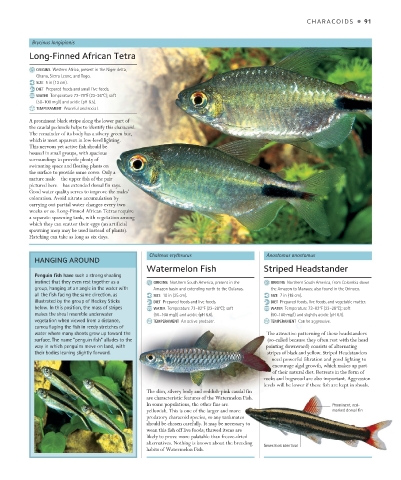
         A prominent black stripe along the lower part of
         the caudal peduncle helps to identify this characoid.
         The remainder of its body has a silvery-green hue,
         which is most apparent in low-level lighting.
         This nervous yet active fish should be
         housed in small groups, with spacious
         surroundings to provide plenty of
         swimming space and floating plants on
         the surface to provide some cover. Only a
         mature male—the upper fish of the pair
         pictured here—has extended dorsal fin rays.
         Good water quality serves to improve the males’
         coloration. Avoid nitrate accumulation by
         carrying out partial water changes every two
         weeks or so. Long-Finned African Tetras require
         a separate spawning tank, with vegetation among
         which they can scatter their eggs (an artificial
         spawning mop may be used instead of plants).
         Hatching can take as long as six days.

                                          Chalceus erythrurus             Anostomus anostomus
           HANGING AROUND
                                         Watermelon Fish                  Striped Headstander
           Penguin fish have such a strong shoaling
           instinct that they even rest together as a   ORIGINS  Northern South America, present in the   ORIGINS  Northern South America, from Colombia down
           group, hanging at an angle in the water with   Amazon basin and extending north to the Guianas.  the Amazon to Manaus; also found in the Orinoco.
           all the fish facing the same direction, as   SIZE  10 in (25 cm).  SIZE  7 in (18 cm).
           illustrated by the group of Hockey Sticks   DIET  Prepared foods and live foods.  DIET  Prepared foods, live foods, and vegetable matter.
           below. In this position, the mass of stripes   WATER  Temperature 73–82°F (23–28°C); soft    WATER  Temperature 73–82°F (23–28°C); soft
           makes the shoal resemble underwater   (50–100 mg/l) and acidic (pH 6.0).  (50–100 mg/l) and slightly acidic (pH 6.5).
           vegetation when viewed from a distance,   TEMPERAMENT  An active predator.  TEMPERAMENT  Can be aggressive.
           camouflaging the fish in reedy stretches of
           water where many shoots grow up toward the                      The attractive patterning of these headstanders
           surface. The name “penguin fish” alludes to the                 (so-called because they often rest with the head
           way in which penguins move on land, with                       pointing downward) consists of alternating
           their bodies leaning slightly forward.                          stripes of black and yellow. Striped Headstanders
                                                                            need powerful filtration and good lighting to
                                                                            encourage algal growth, which makes up part
                                                                            of their natural diet. Retreats in the form of
                                                                          rocks and bogwood are also important. Aggression
                                                                          levels will be lower if these fish are kept in shoals.
                                         The slim, silvery body and reddish-pink caudal fin
                                         are characteristic features of the Watermelon Fish.
                                         In some populations, the other fins are             Prominent, red-
                                         yellowish. This is one of the larger and more       marked dorsal fin
                                         predatory characoid species, so any tankmates
                                         should be chosen carefully. It may be necessary to
                                         wean this fish off live foods; thawed items are
                                         likely to prove more palatable than freeze-dried
                                         alternatives. Nothing is known about the breeding   Sexes look identical
                                         habits of Watermelon Fish.


   US_090-091_Characins.indd   91                                                                    29/08/18   4:09 PM

