


Page 91 - Encyclopedia of Aquarium and Pond Fish, 3rd Edition
P. 91
CHARACOIDS    89


          Gasteropelecus sternicla        Carnegiella strigata            Carnegiella myersi
         Silver Hatchetfish              Marbled Hatchetfish              Dwarf Hatchetfish

           ORIGINS  South America, in Surinam and Guyana, plus   ORIGINS  Northern South America, occurring in Guyana   ORIGINS  South America, occurring in the Rio Ucayali,
           southern tributaries of the Amazon.  and the middle Amazon.      Peru, and also in Bolivia.
           SIZE  2 ⁄2 in (6.5 cm).         SIZE  2 ⁄2 in (6 cm).            SIZE  1 in (2.5 cm).
              1
                                               1
           DIET  Live foods preferred, plus flake.  DIET  Small live foods and flake.  DIET  Small live foods and flake.
           WATER  Temperature 73–81°F (23–27°C); hard    WATER  Temperature 75–82°F (24–28°C); soft    WATER  Temperature 73–79°F (23–26°C); soft
           100–150 mg/l) and acidic to neutral (pH 6.0–7.0).  (50–100 mg/l) and acidic (pH 6.0).   (50–100 mg/l) and acidic (pH 6.0).
           TEMPERAMENT  Peaceful and social, but nervous.  TEMPERAMENT  Social and inoffensive.  TEMPERAMENT  Social and inoffensive.
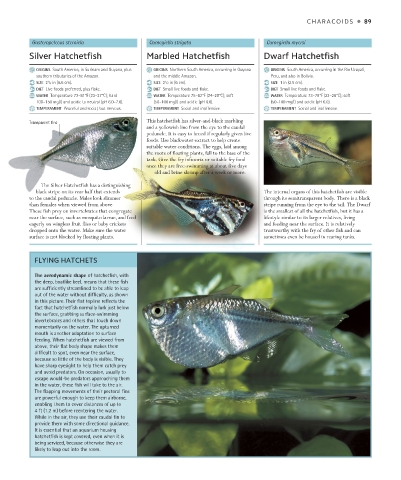
                                         This hatchetfish has silver-and-black marbling
         Transparent fins
                                         and a yellowish line from the eye to the caudal
                                         peduncle. It is easy to breed if regularly given live
                                         foods. Use blackwater extract to help create
                                         suitable water conditions. The eggs, laid among
                                         the roots of floating plants, fall to the base of the
                                         tank. Give the fry infusoria or suitable fry food
                                         once they are free-swimming at about five days
                                            old and brine shrimp after a week or more.
            The Silver Hatchetfish has a distinguishing
           black stripe on its rear half that extends                     The internal organs of this hatchetfish are visible
         to the caudal peduncle. Males look slimmer                       through its semitransparent body. There is a black
         than females when viewed from above                              stripe running from the eye to the tail. The Dwarf
         These fish prey on invertebrates that congregate                 is the smallest of all the hatchetfish, but it has a
         near the surface, such as mosquito larvae, and feed              lifestyle similar to its larger relatives, living
         eagerly on wingless fruit flies or baby crickets                 and feeding near the surface. It is relatively
         dropped onto the water. Make sure the water                      trustworthy with the fry of other fish and can
         surface is not blocked by floating plants.                       sometimes even be housed in rearing tanks.


           FLYING HATCHETS

           The aerodynamic shape of hatchetfish, with
           the deep, boatlike keel, means that these fish
           are sufficiently streamlined to be able to leap
           out of the water without difficulty, as shown
           in this picture. Their flat topline reflects the
           fact that hatchetfish normally lurk just below
           the surface, grabbing surface-swimming
           invertebrates and others that touch down
           momentarily on the water. The upturned
           mouth is another adaptation to surface
           feeding. When hatchetfish are viewed from
           above, their flat body shape makes them
           difficult to spot, even near the surface,
           because so little of the body is visible. They
           have sharp eyesight to help them catch prey
           and avoid predators. On occasion, usually to
           escape would-be predators approaching them
           in the water, these fish will take to the air.
           The flapping movements of their pectoral fins
           are powerful enough to keep them airborne,
           enabling them to cover distances of up to
           4 ft (1.2 m) before reentering the water.
           While in the air, they use their caudal fin to
           provide them with some directional guidance.
           It is essential that an aquarium housing
           hatchetfish is kept covered, even when it is
           being serviced, because otherwise they are
           likely to leap out into the room.


   US_088-089_Characins_Intro.indd   89                                                              29/08/18   4:09 PM

