


Page 94 - Encyclopedia of Aquarium and Pond Fish, 3rd Edition
P. 94
92    FRESHWATER FISH DIRECTORY


           DREADED HUNTERS

           Few fish inspire greater fear than piranhas.
           While many predatory fish live solitary lives,
           piranhas are like packs of wolves, living and
           hunting together in groups and occasionally
           taking prey as large as horses or even people.
           Indeed, keeping these notorious fish is
           outlawed in some parts of the world because
           of fears over their likely impact if they were
           to become established in the wild outside
           their normal range. Piranhas have a sharp
           sense of smell, which enables them to detect
           blood in the water. Repeated splashing,
           indicating a creature out of its depth, is
           equally likely to attract the attention of a
           hungry shoal. They then go into a feeding
           frenzy, ripping repeatedly into their victim,
           using their sharp teeth to pull off mouthfuls
           of flesh. The short upper jaw helps the fish to
           gain a firm anchorage, while the powerful
           lower jaw provides strength, enabling the
           small, triangular, interlocking teeth to shear
           through tissue with ease. Being instinctive
           bullies, piranhas will turn on weak or injured
           members of their own kind, especially if just
           two or three are housed in a tank. A larger
           group, from five upward, will reduce the
           likelihood of this, since there will be less of
           an established hierarchy within the shoal.

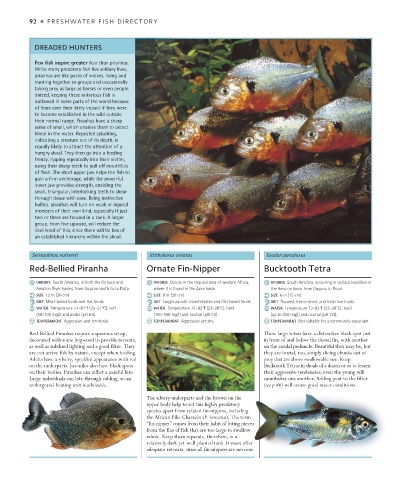
          Serrasalmus nattereri           Ichthyborus ornatus             Exodon paradoxus
         Red-Bellied Piranha             Ornate Fin-Nipper                Bucktooth Tetra

           ORIGINS  South America, in both the Orinoco and   ORIGINS  Occurs in the tropical area of western Africa,   ORIGINS  South America, occurring in various localities in
           Amazon River basins, from Guyana south to La Plata.  where it is found in the Zaire basin.   the Amazon basin from Guyana to Brazil.
           SIZE  12 in (30 cm).            SIZE  8 in (20 cm).              SIZE  6 in (15 cm).
           DIET  Meat-based foods and live foods.   DIET  Larger aquatic invertebrates and fish-based foods.  DIET  Thawed, freeze-dried, and fresh live foods.
           WATER  Temperature 77–81°F (25–27°C); soft    WATER  Temperature 73–82°F (23–28°C); hard    WATER  Temperature 73–82°F (23–28°C); hard
           (50–100 mg/l) and acidic (pH 6.5).  (100–150 mg/l) and neutral (pH 7.0).  (up to 200 mg/l) and neutral (pH 7.0).
           TEMPERAMENT  Aggressive and territorial.  TEMPERAMENT  Aggressive yet shy.  TEMPERAMENT  Not suitable for a community aquarium.
         Red-Bellied Piranhas require a spacious setup,                   These large tetras have a distinctive black spot just
         decorated with some bogwood to provide retreats,                 in front of and below the dorsal fin, with another
         as well as subdued lighting and a good filter. They              on the caudal peduncle. Beautiful they may be, but
         are not active fish by nature, except when feeding.              they are brutal, too, simply slicing chunks out of
         Adults have a silvery, speckled appearance with red              prey that are above swallowable size. Keep
         on the underparts. Juveniles also have black spots               Bucktooth Tetras in shoals of a dozen or so to lessen
         on their bodies. Piranhas can inflict a painful bite.            their aggressive tendencies; even the young will
         Large individuals can bite through cabling, so an                cannibalize one another. Adding peat to the filter
         undergravel heating unit is advisable.                           (see p.46) will create good water conditions.
                                         The silvery underparts and the brown on the
                                         upper body help to set this highly predatory
                                         species apart from related fin-nippers, including
                                         the African Pike Characin (P. loricatus). The term
                                         “fin-nipper” comes from their habit of biting pieces
                                         from the fins of fish that are too large to swallow
                                         whole. Keep them separate, therefore, in a
                                         relatively dark yet well-planted tank. It must offer
                                         adequate retreats, since all fin-nippers are nervous.


   US_092-093_Predatory_Species.indd   92                                                            29/08/18   4:09 PM

