


Page 89 - Encyclopedia of Aquarium and Pond Fish, 3rd Edition
P. 89
CYPRINIDS/BARBS     87


          Puntius bimaculatus
                                                                           BARB BREEDING BEHAVIOR
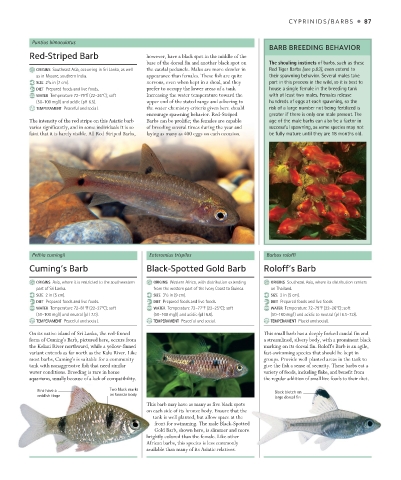
         Red-Striped Barb                however, have a black spot in the middle of the
                                         base of the dorsal fin and another black spot on   The shoaling instincts of barbs, such as these
           ORIGINS  Southeast Asia, occurring in Sri Lanka, as well   the caudal peduncle. Males are more slender in   Red Tiger Barbs (see p.83), even extend to
           as in Mysore, southern India.  appearance than females. These fish are quite   their spawning behavior. Several males take
           SIZE  2 ⁄4 in (7 cm).         nervous, even when kept in a shoal, and they   part in this process in the wild, so it is best to
              3
           DIET  Prepared foods and live foods.  prefer to occupy the lower areas of a tank.   house a single female in the breeding tank
           WATER  Temperature 72–79°F (22–26°C); soft    Increasing the water temperature toward the   with at least two males. Females release
           (50–100 mg/l) and acidic (pH 6.5).   upper end of the stated range and adhering to    hundreds of eggs at each spawning, so the
           TEMPERAMENT  Peaceful and social.  the water chemistry criteria given here should   risk of a large number not being fertilized is
                                         encourage spawning behavior. Red-Striped    greater if there is only one male present. The
         The intensity of the red stripe on this Asiatic barb   Barbs can be prolific; the females are capable    age of the male barbs can also be a factor in
         varies significantly, and in some individuals it is so   of breeding several times during the year and   successful spawning, as some species may not
         faint that it is barely visible. All Red-Striped Barbs,   laying as many as 400 eggs on each occasion.  be fully mature until they are 18 months old.


          Pethia cumingii                 Enteromius trispilos            Barbus roloffi
         Cuming’s Barb                   Black-Spotted Gold Barb          Roloff’s Barb

           ORIGINS  Asia, where it is restricted to the southwestern   ORIGINS  Western Africa, with distribution extending   ORIGINS  Southeast Asia, where its distribution centers
           part of Sri Lanka.              from the western part of the Ivory Coast to Guinea.  on Thailand.
                                               1
           SIZE  2 in (5 cm).              SIZE  3 ⁄2 in (9 cm).            SIZE  2 in (5 cm).
           DIET  Prepared foods and live foods.  DIET  Prepared foods and live foods.  DIET  Prepared foods and live foods
           WATER  Temperature 72–81°F (22–27°C); soft    WATER  Temperature 72–77°F (22–25°C); soft   WATER  Temperature 72–79°F (22–26°C); soft
           (50–100 mg/l) and neutral (pH 7.0).  (50–100 mg/l) and acidic (pH 6.0).  (50–100 mg/l) and acidic to neutral (pH 6.5–7.0).
           TEMPERAMENT  Peaceful and social.  TEMPERAMENT  Peaceful and social.  TEMPERAMENT  Placid and social.
         On its native island of Sri Lanka, the red-finned                This small barb has a deeply forked caudal fin and
         form of Cuming’s Barb, pictured here, occurs from                a streamlined, silvery body, with a prominent black
         the Kelani River northward, while a yellow-finned                marking on its dorsal fin. Roloff’s Barb is an agile,
         variant extends as far north as the Kalu River. Like             fast-swimming species that should be kept in
         most barbs, Cuming’s is suitable for a community                 groups. Provide well-planted areas in the tank to
         tank with nonaggressive fish that need similar                   give the fish a sense of security. These barbs eat a
         water conditions. Breeding is rare in home                       variety of foods, including flake, and benefit from
         aquariums, usually because of a lack of compatibility.           the regular addition of small live foods to their diet.

           Fins have a         Two black marks                               Black blotch on
           reddish tinge       on bronze body                                large dorsal fin
                                         This barb may have as many as five black spots
                                         on each side of its bronze body. Ensure that the
                                           tank is well planted, but allow space at the
                                            front for swimming. The male Black-Spotted
                                            Gold Barb, shown here, is slimmer and more
                                         brightly colored than the female. Like other
                                         African barbs, this species is less commonly
                                         available than many of its Asiatic relatives.


   US_086-087_Barbs3.indd   87                                                                       29/08/18   4:09 PM

