


Page 17 - The Book of Caterpillars: A Life-Size Guide to Six Hundred Species From Around the World
P. 17
FROM EGGS TO PUPATION


            resembling plant parts, fungi, detritus,

            or even bird droppings, caterpillar eggs
            are rarely found by casual observers.
               The eggs usually develop rapidly,
            hatching within two to ten days, de-

            pending on temperature. Sometimes,
            though, they are programmed to delay
            hatching, spending adverse weather
            conditions—extreme cold or heat—in
            a state of developmental arrest, known

            as diapause. They then hatch only when
            the host plants they feed on reappear.                                                15


            LARVAL STAGES

            The caterpillar hatches by cutting a
            hole in the shell with its mandibles and,
            according to species, may consume the
            entire eggshell on the way out or leave
            the empty eggshell with a telltale exit
            hole. The new larva immediately sets

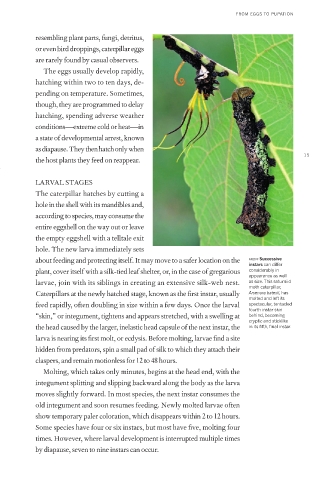
            about feeding and protecting itself. It may move to a safer location on the   ABOVE Successive
                                                                                instars can differ
            plant, cover itself with a silk-tied leaf shelter, or, in the case of gregarious   considerably in
                                                                                appearance as well
            larvae, join with its siblings in creating an extensive silk-web nest.   as size. This saturniid
                                                                                moth caterpillar,
            Caterpillars at the newly hatched stage, known as the first instar, usually   Arsenura batesii, has
                                                                                molted and left its
            feed rapidly, often doubling in size within a few days. Once the larval   spectacular, tentacled
                                                                                fourth instar skin
            “skin,” or integument, tightens and appears stretched, with a swelling at   behind, becoming
                                                                                cryptic and sticklike
            the head caused by the larger, inelastic head capsule of the next instar, the   in its fifth, final instar.
            larva is nearing its first molt, or ecdysis. Before molting, larvae find a site
            hidden from predators, spin a small pad of silk to which they attach their

            claspers, and remain motionless for 12 to 48 hours.
               Molting, which takes only minutes, begins at the head end, with the
            integument splitting and slipping backward along the body as the larva
            moves slightly forward. In most species, the next instar consumes the

            old integument and soon resumes feeding. Newly molted larvae often
            show temporary paler coloration, which disappears within 2 to 12 hours.
            Some species have four or six instars, but most have five, molting four
            times. However, where larval development is interrupted multiple times
            by diapause, seven to nine instars can occur.

