


Page 116 - The Book of Caterpillars: A Life-Size Guide to Six Hundred Species From Around the World
P. 116
BUTTERFLY CATERPILLARS
FAMILY Hesperiidae
DISTRIBUTION Eastern Australia
HABITAT Moist coastal and subcoastal woodlands up to
4,600 ft (1,400 m) elevation
HOST PLANTS Mat rush (Lomandra spp.)
NOTE Caterpillar that is common in urban landscapes
CONSERVATION STATUS Not evaluated, but locally common
ADULT WINGSPAN
1⅝–1⁄ in (42–46 mm)
CATERPILLAR LENGTH
1⁄–1⁄ in (36–40 mm)
TRAPEZITES SYMMOMUS
SPLENDID OCHRE
114
HÜBNER, 1823
Splendid Ochre caterpillars hatch from eggs that are seldom
deposited on the green leaves of the food plant but more often
on dry leaves, flowers, or seed heads. The larva forms an initial
shelter by joining new leaves with silk. In later instars, it rolls one
or more dead or green leaves into a cylindrical tube, emerging
to feed on the end of the sedge blades, usually during the night.
The characteristic V-notches and chewed tip of the blade often
indicate the presence of a caterpillar in a shelter lower down in
the sedge clump.
The caterpillars usually pupate in the final shelter or in leaf litter
under the sedge. In the cooler areas of southeastern Australia,
there is only one generation a year, but there are two generations
in warmer regions. The genus contains 18 species and is
endemic to the Australia faunal region, as is the entire subfamily
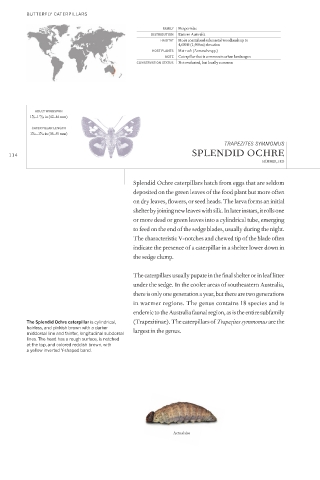
The Splendid Ochre caterpillar is cylindrical, (Trapezitinae). The caterpillars of Trapezites symmomus are the
hairless, and pinkish brown with a darker largest in the genus.
middorsal line and fainter, longitudinal subdorsal
lines. The head has a rough surface, is notched
at the top, and colored reddish brown, with
a yellow inverted Y-shaped band.
Actual size

