


Page 137 - The Book of Caterpillars: A Life-Size Guide to Six Hundred Species From Around the World
P. 137
BUTTERFLY CATERPILLARS

                      FAMILY  Pieridae
                  DISTRIBUTION  Western North America, from British Columbia to New Mexico
                     HABITAT  Arid lands, shrub-steppe, deserts, canyons, and watercourses
                  HOST PLANTS  Rock cress (Arabis spp.), tansymustard (Descurainia spp.),
                           and Tumble Mustard (Sisymbrium altissimum)

                      NOTE  Camouflaged caterpillar that develops rapidly
             CONSERVATION STATUS  Not evaluated, but common within its range


                                                                                   ADULT WINGSPAN
                                                                                  1¾–2 in (45–50 mm)
                                                                                  CATERPILLAR LENGTH
                                                                                    1³∕₁₆ in (30 mm)
            PONTIA BECKERII
            BECKER’S WHITE                                                                       135

            (W. H. EDWARDS, 1871)


            Becker’s White eggs are laid singly on the flowers and seedpods

            of host plants. The caterpillars hatch after three days and
            partially eat their eggshell. Their development is rapid, with
            pupation occurring just 14 days after egg hatch. The whole
            cycle, from egg to emerging butterfly, takes little more than
            three weeks. The caterpillars feed on all parts of the host plant,
            although young instars prefer flowers. No nests are made, and


            survival is based on camouflage. Prepupal caterpillars wander,
            and pupation may occur on or off the host plant.


            The pupa is attached by a silk girdle, usually to a twig, and
            resembles a bird dropping. The number of generations produced
            by this species appears to depend on the quality of the host plant.
            Caterpillars feeding on good-quality hosts produce a further
            generation, while poor-quality hosts result in diapausing pupae.
            Males are aggressive and sometimes “fight” to mate with newly

            emerged females.
                                                                            Actual size


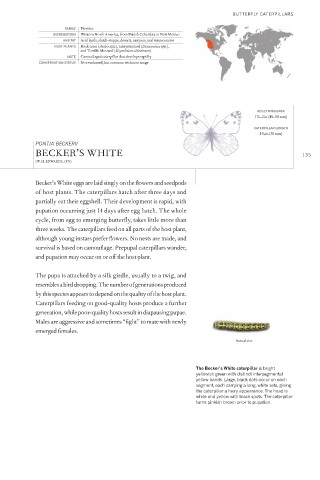
                                                                The Becker’s White caterpillar is bright
                                                                yellowish green with distinct intersegmental
                                                                yellow bands. Large, black dots occur on each
                                                                segment, each carrying a long, white seta, giving
                                                                the caterpillar a hairy appearance. The head is
                                                                white and yellow with black spots. The caterpillar
                                                                turns pinkish brown prior to pupation.

