


Page 136 - The Book of Caterpillars: A Life-Size Guide to Six Hundred Species From Around the World
P. 136
BUTTERFLY CATERPILLARS

                                                     FAMILY  Pieridae
                                                 DISTRIBUTION  Europe, Asia, Africa, North America, Australia, and New Zealand
                                                    HABITAT  All open habitats, especially disturbed areas, croplands,
                                                          gardens, and parks
                                                  HOST PLANTS  Native and commercial crucifers (Brassica spp.)

                                                      NOTE  Most economically damaging butterfly caterpillar pest
                                                          in the world
                                             CONSERVATION STATUS  Not evaluated, but widespread and common


            ADULT WINGSPAN
           1¾–2 in (45–50 mm)
           CATERPILLAR LENGTH
             1³∕₁₆ in (30 mm)
                                                                                 PIERIS RAPAE
                                                                CABBAGE WHITE
    134
                                                                                   (LINNAEUS, 1758)


                                            Cabbage White caterpillars hatch from eggs laid singly on the
                                            underside of host plant leaves; a Cabbage White female lays
                                            up to 750 eggs in a lifetime. The larvae develop rapidly, taking
                                            15 to 20 days from egg hatch to pupation. Most—85 percent—
                                            of their consumption of host plant leaves occurs in the final instar.

                                            Young caterpillars make holes in leaves, while older individuals
                                            eat leaves from the edge. There are five instars and no nests are

                                            made. When temperatures are cool and day lengths less than
                                            13 hours, the developing caterpillars produce diapausing pupae
                                            that overwinter.


                                            Parasitic wasps are important regulators of Cabbage White

                                            populations, parasitizing caterpillars and pupae. Camouflage
                                            helps protect the caterpillars. They also secrete droplets from
                                            their setae that deter ants but may attract wasps. Cabbage
                                            Whites are found mostly in disturbed urban and agricultural
                                            environments and are much less common in wilderness and
                    Actual size             other undisturbed areas.


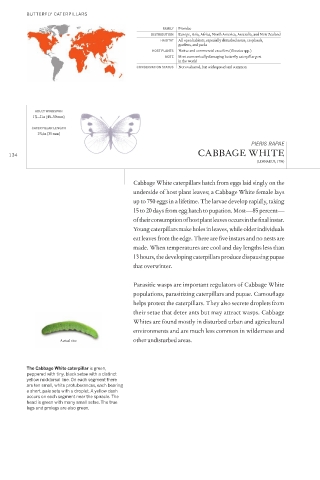
          The Cabbage White caterpillar is green,
          peppered with tiny, black setae with a distinct
          yellow middorsal line. On each segment there
          are ten small, white protuberances, each bearing
          a short, pale seta with a droplet. A yellow dash
          occurs on each segment near the spiracle. The
          head is green with many small setae. The true
          legs and prolegs are also green.

