


Page 138 - The Book of Caterpillars: A Life-Size Guide to Six Hundred Species From Around the World
P. 138
BUTTERFLY CATERPILLARS

                                                     FAMILY  Pieridae
                                                 DISTRIBUTION  Western North America, from Alaska and British Columbia to
                                                          California and New Mexico
                                                    HABITAT  Open areas in mountains and high plains
                                                  HOST PLANTS  Mustard family, such as rockcress (Arabis spp.), tansymustard
                                                          (Descurainia spp.), whitlow grass (Draba spp.), and peppergrass
                                                          (Lepidium spp.)
                                                      NOTE  Species whose life cycle may be accelerated at high altitudes
                                             CONSERVATION STATUS  Not evaluated, but usually common within its range


            ADULT WINGSPAN
           1½–2¹∕₁₆ in (38–53 mm)
           CATERPILLAR LENGTH
             1⅜ in (35 mm)
                                                                          PONTIA OCCIDENTALIS
                                                               WESTERN WHITE
    136
                                                                                    (REAKIRT, 1866)


                                            Western White caterpillars hatch from single yellowish eggs
                                            that turn orange; to ensure the offspring have enough to eat, the

                                            adult female lays only on a plant where no other butterfly eggs

                                            are present. The young caterpillars feed on the host plant leaves,
                                            also ingesting the mustard oils they contain, which make the
                                            larvae distasteful to birds. The caterpillars may have only four
                                            instars and can reach pupation within a week as an adaptation to
                                            the unpredictable and ephemeral climate of higher elevations.
                                            The pupae hibernate attached to a twig by the abdomen tip
                                            and a silken belt.


                                            There is just one generation at high altitudes but several at
                                            lower altitudes. Western White caterpillars eat dozens of plants
                                            in the mustard family (Cruciferae) but prefer to eat flowers
                                            and young fruits, so, unlike Cabbage White (Pieris rapae)
                                            caterpillars, they are not pests on cabbage. Caterpillars of several
                                            closely related species—especially P. protodice—are similar to
                                            the Western White.


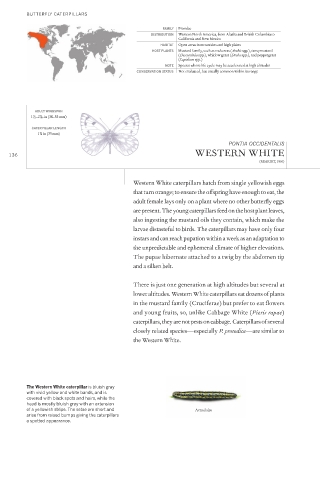
          The Western White caterpillar is bluish gray
          with vivid yellow and white bands, and is
          covered with black spots and hairs, while the
          head is mostly bluish gray with an extension
          of a yellowish stripe. The setae are short and       Actual size
          arise from raised bumps giving the caterpillars
          a spotted appearance.

