


Page 139 - The Book of Caterpillars: A Life-Size Guide to Six Hundred Species From Around the World
P. 139
BUTTERFLY CATERPILLARS

                      FAMILY  Pieridae
                  DISTRIBUTION  Western North America, from northwest Canada to
                           southern California
                     HABITAT  Rocky desert steppe, subalpine ridges, hills, and canyons
                  HOST PLANTS  Rock cress (Arabis spp.), tansymustard (Descurainia spp.),
                           and Tumble Mustard (Sisymbrium altissimum)

                      NOTE  Spectacularly colored caterpillar of a high desert butterfly
             CONSERVATION STATUS  Not evaluated, but widespread in western United States;
                           more scattered in Canada


                                                                                   ADULT WINGSPAN
                                                                                  1⅜–1⁹∕₁₆ in (35–40 mm)
                                                                                  CATERPILLAR LENGTH
                                                                                    1³∕₁₆ in (30 mm)
            PONTIA SISYMBRYII
            SPRING WHITE                                                                         137

            (BOISDUVAL, 1852)


            The eggs of the Spring White are laid singly on the flowers
            of host plants and hatch within two to three days. First instars
            do not eat their eggshells but will cannibalize any nearby eggs.

            They feed ravenously, consuming mostly leaves but also flowers
            and seedpods; a single individual is capable of defoliating
            a plant. The caterpillars feed and rest positioned parallel to
            stems, seedpods, or leaf veins and do not construct nests.

            They are well camouflaged in early instars but develop bright
            aposematic colors in later instars, suggesting that they are
            distasteful to predators.


            Spring White caterpillars grow rapidly through five instars
            and reach pupation about 20 days after hatching. There is
            only one spring generation a year, and the pupa oversummers
            and overwinters. Pupal diapause for up to four years has been
            reported. The caterpillars are vulnerable to viral and bacterial
            disease and infections.


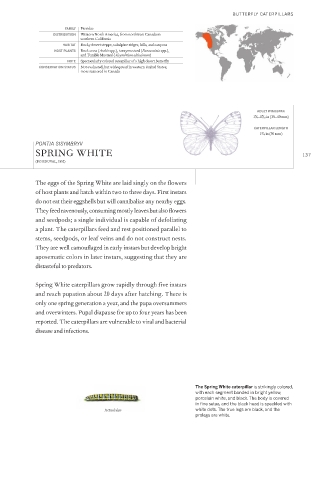
                                                               The Spring White caterpillar is strikingly colored,
                                                               with each segment banded in bright yellow,
                                                               porcelain white, and black. The body is covered
                                                               in   ne setae, and the black head is speckled with
                                  Actual size                  white dots. The true legs are black, and the
                                                               prolegs are white.

