


Page 140 - The Book of Caterpillars: A Life-Size Guide to Six Hundred Species From Around the World
P. 140
BUTTERFLY CATERPILLARS

                                                     FAMILY  Riodinidae
                                                 DISTRIBUTION  Southwestern Canada, western United States, and Mexico

                                                    HABITAT  Desert canyons, arid flats, banks, and roadsides
                                                  HOST PLANTS  Buckwheat (Eriogonum spp.)

                                                      NOTE  Slow-growing caterpillar that becomes a fiery-colored,
                                                          fall butterfly

                                             CONSERVATION STATUS  Not evaluated, although subspecies Apodemia mormo langei
                                                          is critically imperiled


            ADULT WINGSPAN
             1¼ in (32 mm)
           CATERPILLAR LENGTH
             1¹∕₁₆ in (27 mm)
                                                                             APODEMIA MORMO
                                                      MORMON METALMARK
    138
                                                                               (FELDER & FELDER, 1859)


                                            In northern parts of its range, the Mormon Metalmark caterpillar
                                            develops very slowly during spring and summer, spending much
                                            time in apparent dormancy. Late instars may make loose silk
                                            nests to rest in. Pupation occurs in late summer, and the butterfly


                                            flies in early fall. The eggs develop embryos but then diapause
                                            and overwinter. Caterpillar survival appears to depend on
                      Actual size           concealment in refugia, but the bright purple and gold coloration
                                            may be aposematic. The caterpillars feed on many buckwheat
                                            species, chewing small holes through the leaves.


                                            Approximately 15 closely related metalmark butterfly species

                                            occur from Canada to Brazil. The seasonality of these species
                                            (including Apodemia mormo) varies according to latitude, with
                                            more southerly species having earlier and longer flight periods.

                                            Young caterpillars—instead of eggs—may overwinter in lower
                                            latitude populations. The subspecies A. mormo langei, which
                                            occurs in the Antioch Dunes of California, is endangered due
                                            to loss of habitat and host plants.


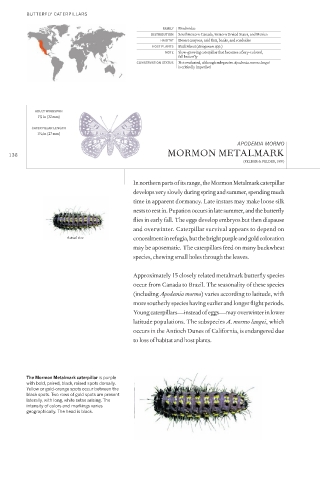
         The Mormon Metalmark caterpillar is purple
         with bold, paired, black, raised spots dorsally.
         Yellow or gold-orange spots occur between the
         black spots. Two rows of gold spots are present
         laterally, with long, white setae arising. The
         intensity of colors and markings varies
         geographically. The head is black.

