


Page 141 - The Book of Caterpillars: A Life-Size Guide to Six Hundred Species From Around the World
P. 141
BUTTERFLY CATERPILLARS
FAMILY Riodinidae
DISTRIBUTION Trinidad and the Amazon basin, south to central Brazil and
east-central Peru
HABITAT Margins of streams, ponds, and oxbow lakes
HOST PLANTS Aquatic Montrichardia spp.
NOTE Beautiful caterpillar rarely seen outside of its leaf shelter
CONSERVATION STATUS Not evaluated, but not considered threatened
ADULT WINGSPAN
1⁄–1⁄ in (36–40 mm)
CATERPILLAR LENGTH
1–1⁄ in (25–30 mm)
HELICOPIS CUPIDO
SPANGLED CUPID 139
(LINNAEUS, 1758)
Spangled Cupid caterpillars live and feed within the tightly
rolled new leaves of their host plants. To prevent these leaves
from unrolling as they develop, the larvae silk them tightly
closed. Repeated oviposition by adults results in the presence
of several generations of larvae living together within these
shelters. As adults, both sexes are usually found resting under
the leaves of tall vegetation growing around the edges of lagoons Actual size
or slow-moving backwaters, flying only infrequently, usually to
swirl about chasing other Helicopis cupido butterflies.
The most remarkable feature of Spangled Cupid caterpillars
is their large cluster of balloon setae on the prothoracic shield.
This and similar structures are unique to the Riodinidae, and
they are known from both myrmecophilous (ant attended)
and non-myrmecophilous genera, although rare overall.
The exact function of these setae is unknown, but they may
store and disperse noxious defensive chemicals, as well as
facilitate symbiotic relationships with ants. Internally, the
balloon setae are filled with a spongy material consisting of
a dense latticework of tiny strands.
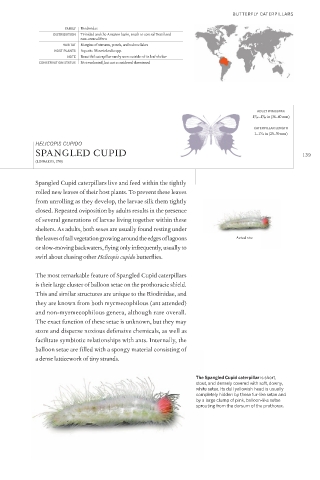
The Spangled Cupid caterpillar is short,
stout, and densely covered with soft, downy,
white setae. Its dull yellowish head is usually
completely hidden by these fur-like setae and
by a large clump of pink, balloon-like setae
sprouting from the dorsum of the prothorax.

