


Page 153 - The Book of Caterpillars: A Life-Size Guide to Six Hundred Species From Around the World
P. 153
BUTTERFLY CATERPILLARS
FAMILY Lycaenidae
DISTRIBUTION Eastern Australia
HABITAT Rain-forest margins in the north and tall eucalypt forests in
the south
HOST PLANTS Elderberry Panax (Polyscias sambucifolia) and Celery Wood
(Polyscias elegans)
NOTE Caterpillar that feeds on flower buds
CONSERVATION STATUS Not evaluated, but locally common in northern areas, although
rarer in the south
ADULT WINGSPAN
1⁄ in (30 mm)
CATERPILLAR LENGTH
⅝ in (16 mm)
CANDALIDES CONSIMILIS
DARK PENCILLED-BLUE 151
WATERHOUSE, 1942
Dark Pencilled-blue caterpillars hatch from eggs laid on small
flower buds. The larvae eat through the side of the flower buds,
remaining on the outside, and consume the anthers. Older
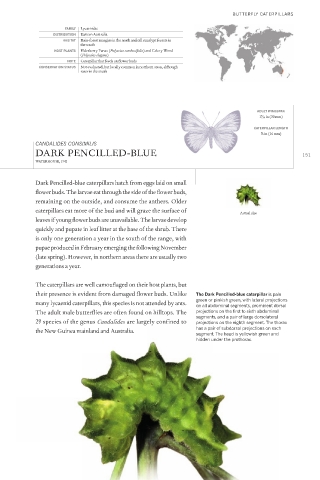
caterpillars eat more of the bud and will graze the surface of Actual size
leaves if young flower buds are unavailable. The larvae develop
quickly and pupate in leaf litter at the base of the shrub. There
is only one generation a year in the south of the range, with
pupae produced in February emerging the following November
(late spring). However, in northern areas there are usually two
generations a year.
The caterpillars are well camouflaged on their host plants, but
their presence is evident from damaged flower buds. Unlike The Dark Pencilled-blue caterpillar is pale
many lycaenid caterpillars, this species is not attended by ants. green or pinkish green, with lateral projections
on all abdominal segments, prominent dorsal
The adult male butterflies are often found on hilltops. The projections on the rst to sixth abdominal
29 species of the genus Candalides are largely confined to segments, and a pair of large dorsolateral
projections on the eighth segment. The thorax
the New Guinea mainland and Australia. has a pair of subdorsal projections on each
segment. The head is yellowish green and
hidden under the prothorax.

