


Page 156 - The Book of Caterpillars: A Life-Size Guide to Six Hundred Species From Around the World
P. 156
BUTTERFLY CATERPILLARS
FAMILY Lycaenidae
DISTRIBUTION Southern Florida, the Bahamas, Cuba, and the Cayman Islands
HABITAT Open areas and suburbs where host plants grow
HOST PLANTS Cycad, including Zamia pumila and Cycas revoluta
NOTE Caterpillar protected by cyanogenic compounds derived
from its host plants
CONSERVATION STATUS Not evaluated, but a Florida subspecies was close to extinction
due to overharvesting of its host plant, although it has lately
shown a strong recovery
ADULT WINGSPAN
1⁄–2⅛ in (40–54 mm)
CATERPILLAR LENGTH
1 in (25 mm)
EUMAEUS ATALA
ATALA
154
(POEY, 1832)
Atala caterpillars hatch from cream-colored eggs laid in groups
on the leaf tips of the host plant and feed in groups, skeletonizing
the tough cuticle of the leaves. They soon become brightly
colored and gain a protective toxic chemical—cycasin—
from the plants they feed on. They remain gregarious until
almost the end of the larval stage. While most Lepidoptera
have a fixed number of larval instars, the Atala caterpillar,
if deprived of food, will pupate from as early as the end of the
third instar, resulting in a smaller adult. The normal number
of instars is five.
To pupate, larvae crawl away from their final feeding site and
create mats of silk to which the pupae are attached. Pupation
Actual size can occur in large clusters. As the pupae remain protected by
the toxic chemicals sequestered by the caterpillar, a single pupa
tasted and rejected by a predator can protect the whole group
from harm. However, some predators can tolerate the toxic
chemicals; these include assassin and ambush bugs (Reduviidae),
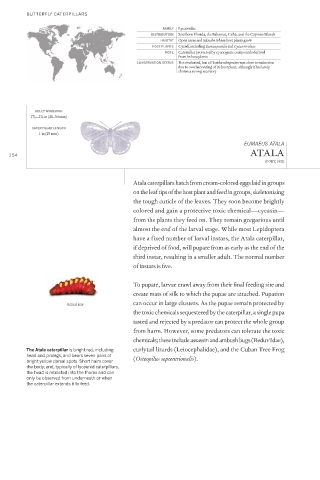
The Atala caterpillar is bright red, including curlytail lizards (Leiocephalidae), and the Cuban Tree Frog
head and prolegs, and bears seven pairs of (Osteopilus septentrionalis).
bright yellow dorsal spots. Short hairs cover
the body, and, typically of lycaenid caterpillars,
the head is retracted into the thorax and can
only be observed from underneath or when
the caterpillar extends it to feed.

