


Page 150 - The Book of Caterpillars: A Life-Size Guide to Six Hundred Species From Around the World
P. 150
BUTTERFLY CATERPILLARS

                                                     FAMILY  Lycaenidae
                                                 DIS
                                                   TRIBUTION
                                                 DISTRIBUTION
                                                 DISTRIBUTION  North America


                                                    HABIT
                                                    HABITAT T  Bluffs, open fields, forest edges, and dry, rocky open places
                                                    HABITAT
                                                       A
                                                  HOS
                                                  HOST PLANTS
                                                  HOST PLANTS S  Juniper (Juniperus spp.) and cedar (Thuja spp., Cupressus spp.)
                                                    T PLANT
                                                      NOTE
                                                      NOTE  Green caterpillar that turns pink just before pupation
                                                       TE
                                                      NO
                                             CONSERVATION STATUS  Not evaluated, but at least one subspecies is thought vulnerable
                                             CONSERV
                                             CONSERVATION STATUS
                                                     T
                                                  TION S
                                                      A
                                                      TUS
                                                 A
            ADULT WINGSPAN
           1–1³∕₁₆ in (25–30 mm)
           CATERPILLAR LENGTH
             ⁹∕₁₆ in (15 mm)
                                                                          CALLOPHRYS GRYNEUS
                                                        JUNIPER HAIRSTREAK
    148
                                                                                   (HÜBNER, [1819])
                                            Juniper Hairstreak caterpillars are well adapted to feeding
                                            on junipers and cedars and do so throughout the United States.
                                            The superb camouflage of this caterpillar blends in particularly

                                            well with its host plants, and is clearly the basis of its survival
                                            strategy. Development from egg hatch to pupation takes 30 to
                                            50 days depending on temperature. The caterpillars feed entirely
                                            on juniper needles, excavating holes on the upper surfaces in
                                            early instars, then consuming the needles when more mature.
                                            The larvae are solitary, and cannibalism can occur in captivity.


                                            A great deal of comparative work has been done on the adults
                                            of Callophrys gryneus and on analysis of blend zones where
                                            subspecies meet. Nevertheless, dialogue continues as to whether
                                            this is truly a single species. Much less attention has been given to
                                            the comparative biology of the immature stages. The caterpillars
                                            usually change color to fuchsia pink and wander just prior to

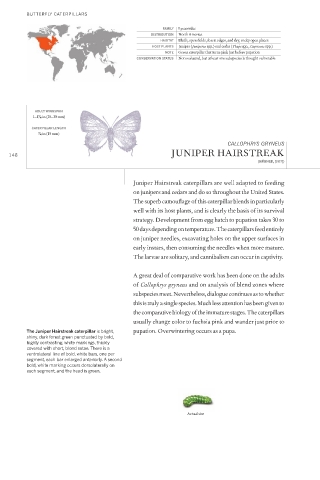
          The Juniper Hairstreak caterpillar is bright,   pupation. Overwintering occurs as a pupa.
          shiny, dark forest green punctuated by bold,
          highly contrasting, white markings, thickly
          covered with short, blond setae. There is a
          ventrolateral line of bold, white bars, one per
          segment, each bar enlarged anteriorly. A second
          bold, white marking occurs dorsolaterally on
          each segment, and the head is green.


                                                             Actual size

