


Page 148 - The Book of Caterpillars: A Life-Size Guide to Six Hundred Species From Around the World
P. 148
BUTTERFLY CATERPILLARS
FAMILY Lycaenidae
DISTRIBUTION Southern Africa; also introduced into Mediterranean Europe
and Morocco
HABITAT Dry slopes, gardens, and parks
HOST PLANTS Geranium spp. and Pelargonium spp.
NOTE Hairy caterpillar that is a horticultural pest in many countries
CONSERVATION STATUS Not evaluated, but increasing its range
ADULT WINGSPAN
⁄–1 in (15–25 mm)
CATERPILLAR LENGTH
½ in (13 mm)
CACYREUS MARSHALLI
GERANIUM BRONZE
146
BUTLER, 1897
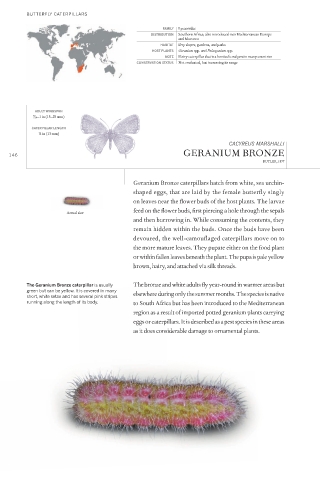
Geranium Bronze caterpillars hatch from white, sea urchin-
shaped eggs, that are laid by the female butterfly singly
on leaves near the flower buds of the host plants. The larvae
feed on the flower buds, first piercing a hole through the sepals
Actual size
and then burrowing in. While consuming the contents, they
remain hidden within the buds. Once the buds have been
devoured, the well-camouflaged caterpillars move on to
the more mature leaves. They pupate either on the food plant
or within fallen leaves beneath the plant. The pupa is pale yellow
brown, hairy, and attached via silk threads.
The Geranium Bronze caterpillar is usually The bronze and white adults fly year-round in warmer areas but
green but can be yellow. It is covered in many elsewhere during only the summer months. The species is native
short, white setae and has several pink stripes
running along the length of its body. to South Africa but has been introduced to the Mediterranean
region as a result of imported potted geranium plants carrying
eggs or caterpillars. It is described as a pest species in these areas
as it does considerable damage to ornamental plants.

