


Page 155 - The Book of Caterpillars: A Life-Size Guide to Six Hundred Species From Around the World
P. 155
BUTTERFLY CATERPILLARS

                      FAMILY  Lycaenidae
                  DISTRIBUTION  Western North America, from British Columbia south to
                           California and southeast to Texas
                     HABITAT  Shrubby riparian areas from sea level to high elevations
                  HOST PLANTS  Wide variety of shrubs and bushes, including Mountain Balm
                           (Ceanothus greggii), many other Ceanothus spp., and Red Osier
                           Dogwood (Cornus sericea)

                      NOTE  Caterpillar that is variably colored for better camouflage on

                           different host plants
             CONSERVATION STATUS  Not evaluated, but common within its range


                                                                                   ADULT WINGSPAN
                                                                                  1–1⅛ in (25–28 mm)
                                                                                  CATERPILLAR LENGTH
                                                                                    ⁹∕₁₆ in (14 mm)
            CELASTRINA ECHO
            ECHO BLUE                                                                            153

            (W. H. EDWARDS, 1864)


            The Echo Blue caterpillar hatches in two days from eggs that
            the adult female lays singly among terminal buds, pushing
            them as far out of sight as possible. The first instar chews round

            holes into buds, hollowing out the inside. The caterpillars do
            not fully enter the buds but often have their heads and necks
            extended deeply. They feed voraciously and forcibly eject
            frass, which prevents contamination of feeding sites and
            helps conceal their presence from predators; small predatory
            bugs take a large number of larvae. The larvae develop rapidly
            through four instars, taking as little as 12 to 14 days from egg
            hatch to pupation.


            Mature caterpillars pupate under cover away from the plant,
            and the pupa overwinters. One to three broods are produced
            annually, depending on habitat latitude and elevation. The
            color variation apparent in the caterpillars may be influenced

            by host plant coloration. The Echo Blue is one of a number
            of closely related blue butterflies occurring throughout
            North America and Eurasia.
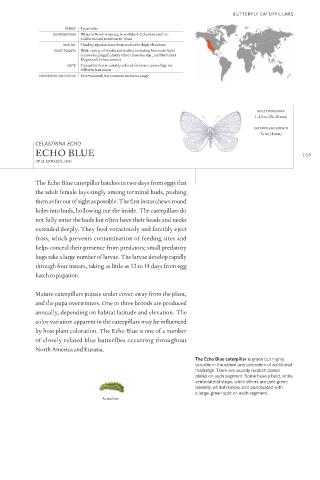
                                                               The Echo Blue caterpillar is green but highly
                                                               variable in the extent and coloration of additional
                                                               markings. There are usually reddish dorsal
                                                               plates on each segment. Some have a bold, white
                                                               ventrolateral stripe, while others are pale green
                                                               laterally, whitish below, and punctuated with
                                                               a large, green spot on each segment.
                                  Actual size

