


Page 157 - The Book of Caterpillars: A Life-Size Guide to Six Hundred Species From Around the World
P. 157
BUTTERFLY CATERPILLARS

                      FAMILY  Lycaenidae
                    TRIBUTION
                  DISTRIBUTION  Northwestern United States (Washington State, Oregon)
                  DIS
                  DISTRIBUTION
                     HABIT
                        A
                     HABITAT T  Open areas in moderate to high elevation forests and shrub-steppe
                     HABITAT
                  HOST PLANTS S  Sulphur Buckwheat (Eriogonum umbellatum)
                    T PLANT
                  HOS
                  HOST PLANTS
                      NOTE
                        TE
                      NOTE  One of many Euphilotes caterpillars in western North America
                      NO
             CONSERV A TION S T A TUS  Not evaluated
             CONSERVATION STATUS
             CONSERVATION STATUS
                                                                                   ADULT WINGSPAN
                                                                                   ⅞–1 in (23–25 mm)
                                                                                  CATERPILLAR LENGTH
                                                                                    ⁷∕₁₆ in (11 mm)
            EUPHILOTES GLAUCON
            SUMMIT BLUE                                                                          155
            (W. H. EDWARDS, 1871)


            Summit Blue caterpillars hatch from their eggs in five days. The

            first instars do not eat their eggshells but feed primarily on the

            buds, flowers, and fruits of the host plant. When feeding on
            seeds, the caterpillars cut small, round holes and hollow out
            the insides with their extendable necks. Development from
            egg hatch to pupation takes around 30 days. The caterpillars
            are solitary and do not construct nests. The primary survival
            strategy appears to be camouflage, although ants may also
            attend and protect the caterpillars from the parasites that
            commonly attack them.


            The pupae overwinter, with adults emerging in the spring.
            Adult Summit Blues associate closely with the host plant, the
            females flying from flower to flower, bending their abdomens       Actual size


            to lay eggs on the blossoms of freshly opened blooms and
            avoiding the more mature ones. Females lay their eggs singly,

            almost always on the inside parts of an open flower. There is a
            single generation annually.
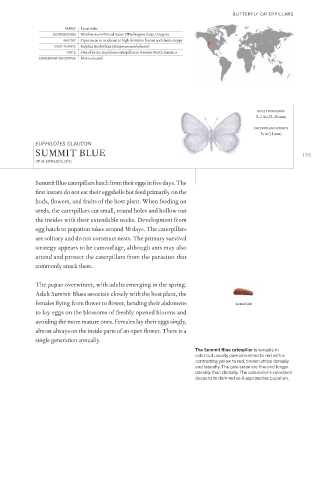
                                                               The Summit Blue caterpillar is variable in
                                                               color but usually pale cinnamon to red with a
                                                               contrasting yellow to red, broken stripe dorsally
                                                               and laterally. The pale setae are   ne and longer
                                                               laterally than dorsally. The caterpillar’s coloration
                                                               deepens to dark red as it approaches pupation.

