


Page 152 - The Book of Caterpillars: A Life-Size Guide to Six Hundred Species From Around the World
P. 152
BUTTERFLY CATERPILLARS

                                                     FAMILY  Lycaenidae
                                                   TRIBUTION
                                                 DIS
                                                 DISTRIBUTION  Western North America, from southern Canada to Mexico
                                                 DISTRIBUTION
                                                    HABITAT
                                                    HABIT A T  Low to high elevation clearings in conifer forests
                                                    HABITAT
                                                  HOST PLANTS S  Dwarf mistletoe (Arceuthobium spp.)
                                                  HOST PLANTS
                                                  HOS
                                                    T PLANT
                                                      NOTE
                                                      NO
                                                       TE
                                                      NOTE  Caterpillar that feeds on conifer-infesting mistletoes
                                             CONSERVATION STATUS  Not evaluated, but possibly rare at the periphery of its range
                                             CONSERVATION STATUS
                                             CONSERV
                                                      TUS
                                                  TION S
                                                     T
                                                      A
                                                 A
            ADULT WINGSPAN
           1–1¼ in (25–32 mm)
           CATERPILLAR LENGTH
             11 ∕₁₆ in (17 mm)
                                                                       CALLOPHRYS SPINETORUM
                                                      THICKET HAIRSTREAK
    150
                                                                                  (HEWITSON, 1867)
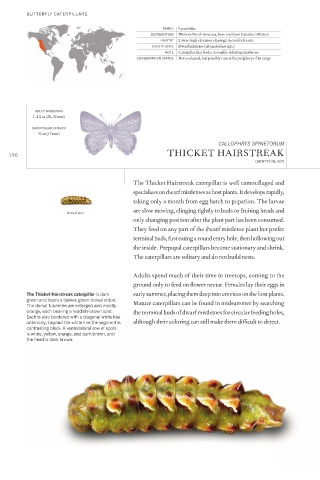
                                            The Thicket Hairstreak caterpillar is well camouflaged and
                                            specializes on dwarf mistletoes as host plants. It develops rapidly,
                                            taking only a month from egg hatch to pupation. The larvae
                                            are slow moving, clinging tightly to buds or fruiting heads and
                      Actual size
                                            only changing position after the plant part has been consumed.
                                            They feed on any part of the dwarf mistletoe plant but prefer

                                            terminal buds, first eating a round entry hole, then hollowing out
                                            the inside. Prepupal caterpillars become stationary and shrink.
                                            The caterpillars are solitary and do not build nests.


                                            Adults spend much of their time in treetops, coming to the

                                            ground only to feed on flower nectar. Females lay their eggs in
          The Thicket Hairstreak caterpillar is dark   early summer, placing them deep into crevices on the host plants.
          green and bears a darker, green dorsal stripe.   Mature caterpillars can be found in midsummer by searching
          The dorsal tubercles are enlarged and mostly
          orange, each bearing a reddish-brown spot.   the terminal buds of dwarf mistletoes for circular feeding holes,
          Each is also bordered with a diagonal white line


          anteriorly; beyond the white line the segment is   although their coloring can still make them difficult to detect.
          contrasting black. A ventrolateral row of spots
          is white, yellow, orange, and dark brown, and
          the head is dark brown.

