


Page 154 - The Book of Caterpillars: A Life-Size Guide to Six Hundred Species From Around the World
P. 154
BUTTERFLY CATERPILLARS

                                                     FAMILY  Lycaenidae
                                                 DISTRIBUTION  East, southeast, and other scattered areas of Australia
                                                    HABITAT  Wide range, from coastal heathland to arid and
                                                          subalpine woodlands
                                                  HOST PLANTS  Native and introduced plantain (Plantago spp.) and plants from
                                                          Lamiaceae, Myoporaceae, Scrophulariaceae, and Thymelaeaceae

                                                      NOTE  Well-camouflaged caterpillar often located only by a feeding scar
                                             CONSERVATION STATUS  Not evaluated, but locally common


            ADULT WINGSPAN
           1–1¼ in (25–32 mm)
           CATERPILLAR LENGTH
             11 ∕₁₆ in (17 mm)
                                                                            CANDALIDES HEATHI
                                                                       RAYED BLUE
    152
                                                                                      (COX, 1873)


                                            The Rayed Blue caterpillar feeds openly on the underside of
                                            leaves, producing irregular patches with the upper leaf cuticle
                                            and the veins remaining intact. Older caterpillars consume
                                            greater portions of the leaves. The larvae feed largely at night
                                            and rest during the day on the underside of lower leaves. They
                                            are sometimes attended by a few small, black ants but are usually
                                            unattended. The caterpillars complete development within three
                                            to five weeks.


                                            Pupation occurs on the underside of leaves, on stems, or under
                                            litter at the base of the host plant. The pupa is attached by anal
                                            hooks and a central girdle. There is one generation a year in
                                            southern areas of Australia, with dormant pupae overwintering.
                                            However, in the warmer northern regions, pupal dormancy
                                            seems to be broken by rain, and breeding occurs throughout
                                            much of the year. Pupal dormancy can last more than 20 months.


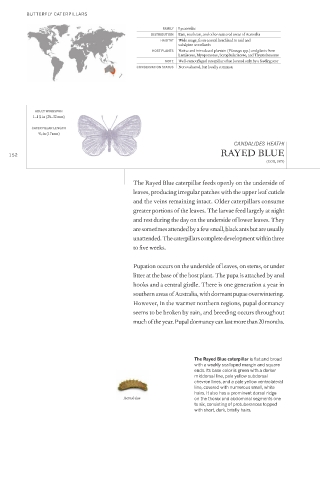
                                                               The Rayed Blue caterpillar is   at and broad
                                                               with a weakly scalloped margin and square
                                                               ends. Its base color is green with a darker
                                                               middorsal line, pale yellow subdorsal
                                                               chevron lines, and a pale yellow ventrolateral
                                                               line, covered with numerous small, white
                                                               hairs. It also has a prominent dorsal ridge
                                        Actual size            on the thorax and abdominal segments one
                                                               to six, consisting of protuberances topped
                                                               with short, dark, bristly hairs.

