


Page 149 - The Book of Caterpillars: A Life-Size Guide to Six Hundred Species From Around the World
P. 149
BUTTERFLY CATERPILLARS

                      FAMILY  Lycaenidae
                  DIS TRIBUTION  Southern Canada, western United States
                  DISTRIBUTION
                  DISTRIBUTION
                     HABIT A T  Openings in coniferous forests
                     HABITAT
                     HABITAT
                  HOS T PLANT S  Pine (Pinus spp.)
                  HOST PLANTS
                  HOST PLANTS
                      NOTE
                        TE
                      NOTE  Wonderfully cryptic caterpillar that is found among pine needles
                      NO
             CONSERVATION STATUS
             CONSERV
                   TION S
                  A
             CONSERVATION STATUS  Not evaluated, but common and secure within its range
                      T
                       TUS
                       A
                                                                                   ADULT WINGSPAN
                                                                                  1–1³∕₁₆ in (25–30 mm)
                                                                                  CATERPILLAR LENGTH
                                                                                    ⁹∕₁₆ in (15 mm)
            CALLOPHRYS ERYPHON
            WESTERN PINE ELFIN                                                                   147
            (BOISDUVAL, 1852)

            Western Pine Elfin caterpillars hatch from eggs laid singly
            on the soft, new-growth branch tips of the host trees. The eggs
            are typically tucked deep into a crevice close to the base of a
            slanted pine needle. The first instar feeds on new-growth       Actual size
            needles at the pine branch tips, mining the surface initially,
            then consuming the needles. Yellow frass is produced in great
            quantities by the caterpillars and may betray their presence.
            However, they are colored and striped identically to the host
            needles, which creates superb camouflage. The larvae are
            solitary and do not make nests.


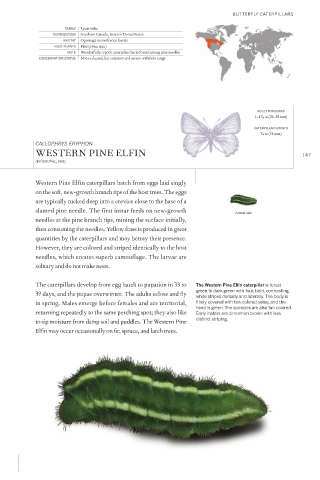
            The caterpillars develop from egg hatch to pupation in 33 to   The Western Pine El n caterpillar is forest


            39 days, and the pupae overwinter. The adults eclose and fly   green to dark green with four, bold, contrasting,
                                                                white stripes dorsally and laterally. The body is
            in spring. Males emerge before females and are territorial,     nely covered with tan-colored setae, and the
            returning repeatedly to the same perching spot; they also like   head is green. The spiracles are also tan colored.
                                                                Early instars are cinnamon brown with less
            to sip moisture from damp soil and puddles. The Western Pine   distinct striping.

            Elfin may occur occasionally on fir, spruce, and larch trees.

