


Page 159 - The Book of Caterpillars: A Life-Size Guide to Six Hundred Species From Around the World
P. 159
BUTTERFLY CATERPILLARS
FAMILY Lycaenidae
DISTRIBUTION Australia, subtropical to temperate east coast
HABITAT Coastal sandstone areas and understory of tall, open
eucalyptus forests
HOST PLANTS Hazel Pomaderris (Pomaderris aspera) and other Pomaderris spp.
NOTE Caterpillar that is well camouflaged but heavily parasitized by flies
CONSERVATION STATUS Not evaluated, but usually uncommon, though occasionally
locally abundant
ADULT WINGSPAN
1–1⅛ in (26–28 mm)
CATERPILLAR LENGTH
¹∕₁₆ in (18 mm)
HYPOCHRYSOPS BYZOS
YELLOW-SPOT JEWEL 157
(BOISDUVAL, 1832)
The Yellow-spot Jewel caterpillar skeletonizes the underside
of the foliage as it feeds. It is difficult to spot as the line on its
back looks like a leaf vein. The caterpillar pupates in a depression
on the underside of the leaf, usually on one that has not been
fed upon. There is one generation a year; the caterpillar stage
lasts ten months with little feeding during the winter months.
Yellow-spot Jewel butterfl ies have brilliant red, orange, and
black bands edged with iridescent green on the underside. They
fly fast and are seldom seen but will bask in the sun and feed at
flowers. The Hypochrysops genus has at least 57 species, mainly
from tropical rain forests of New Guinea and Australia. Unlike
most caterpillars of the genus, this species does not have a close
association with ants, which can help protect against parasitic
insects; tachinid flies often attack the larvae.
Actual size
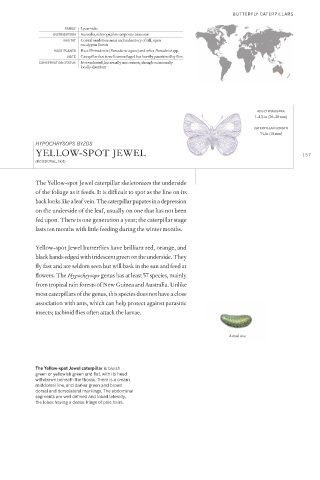
The Yellow-spot Jewel caterpillar is bluish
green or yellowish green and at, with its head
withdrawn beneath the thorax. There is a cream
middorsal line, and darker green and brown
dorsal and dorsolateral markings. The abdominal
segments are well de ned and lobed laterally,
the lobes having a dense fringe of pale hairs.

