


Page 160 - The Book of Caterpillars: A Life-Size Guide to Six Hundred Species From Around the World
P. 160
BUTTERFLY CATERPILLARS
FAMILY Lycaenidae
DISTRIBUTION New Guinea, northern Australia
HABITAT Subcoastal and coastal habitats, including mangroves,
that support the attendant ant
HOST PLANTS Wide range (at least 12 families), including Senna spp.,
Terminalia spp., Smilax spp., Cassia spp., and commonly
mangroves, such as Flagellaria spp. and Ceriops spp.
NOTE Caterpillar that is always attended by protective Green Tree Ants
CONSERVATION STATUS Not evaluated, but locally common
ADULT WINGSPAN
1⁄ in (30 mm)
CATERPILLAR LENGTH
⁄ in (24 mm)
HYPOLYCAENA PHORBAS
BLACK-SPOTTED FLASH
158
(FABRICIUS, 1793)
Black-spotted Flash caterpillars hatch from white, pitted eggs
laid by the female on the underside of a host plant leaf. The
larvae are myrmecophilous—benefited by ants—and invariably
attended and protected by Green Tree Ants (Oecophylla
smaragdina). The caterpillars generally pupate in a shelter on
the food plant but also occasionally in overlapping foliage from
neighboring trees, often in groups. The pupa is attached into
a silk pad by anal hooks and a central, silken girdle. The pupae
Actual size
are also attended by Green Tree Ants.
Hypolycaena phorbas caterpillars can be found throughout the
year, during which time several generations are completed.
They usually hide by day under a leaf or in a leaf shelter and
feed at night on the leaves, young shoots, buds, and flowers of
their food plant. Several caterpillars can be found in a shelter,
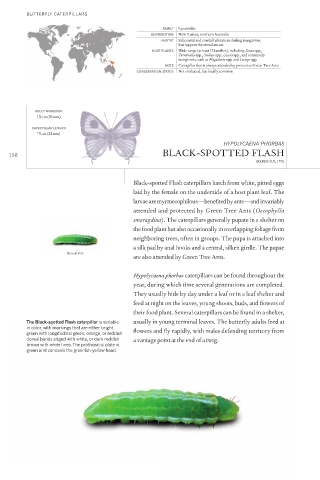
The Black-spotted Flash caterpillar is variable usually in young terminal leaves. The butterfly adults feed at
in color, with markings that are either bright flowers and fly rapidly, with males defending territory from
green with longitudinal green, orange, or reddish
dorsal bands edged with white, or dark reddish a vantage point at the end of a twig.
brown with white lines. The prothoracic plate is
green and conceals the greenish-yellow head.

