


Page 161 - The Book of Caterpillars: A Life-Size Guide to Six Hundred Species From Around the World
P. 161
BUTTERFLY CATERPILLARS
FAMILY Lycaenidae
DIS TRIBUTION Southeastern Australia
DISTRIBUTION
DISTRIBUTION
HABIT A T Open forests and temperate eucalypt woodland
HABITAT
HABITAT
HOS
HOST PLANTS S Wattle (Acacia spp.)
T PLANT
HOST PLANTS
NOTE
NOTE
NO TE Gregarious caterpillar that can emit audible sounds
CONSERV A TION S T A TUS Not evaluated, but locally common
CONSERVATION STATUS
CONSERVATION STATUS
ADULT WINGSPAN
1¼–1⅜ in (32–35 mm)
CATERPILLAR LENGTH
⁄ in (18 mm)
JALMENUS EVAGORAS
IMPERIAL HAIRSTREAK 159
(DONOVAN, 1805)
Imperial Hairstreak caterpillars hatch in the spring from
clusters of overwintering eggs laid in crevices on twigs and bark
during the previous fall, usually on small wattles less than 6 ft
(1.83 m) high. They feed gregariously during the day on the
foliage and are always attended by numerous small, black ants,
usually Iridomyrmex species. The ants, which probably protect
the caterpillars from parasitism and predation, collect secretions
from glands near the rear of the caterpillar’s body. Two or three
Jalmenus evagoras generations are completed each year, and a Actual size
colony can remain on the same or nearby trees for many years.
Pupation of the caterpillars often occurs on a communal web,
the pupae suspended head down by a central girdle and anal
hooks. Both the mature larva and the pupa are capable of making
audible sounds, a feature not uncommon, at least for pupae,
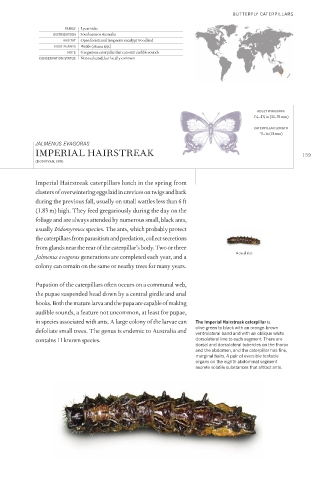
in species associated with ants. A large colony of the larvae can The Imperial Hairstreak caterpillar is
defoliate small trees. The genus is endemic to Australia and olive green to black with an orange-brown
ventrolateral band and with an oblique white
contains 11 known species. dorsolateral line to each segment. There are
dorsal and dorsolateral tubercles on the thorax
and the abdomen, and the caterpillar has ne,
marginal hairs. A pair of eversible tentacle
organs on the eighth abdominal segment
secrete volatile substances that attract ants.

