


Page 227 - The Book of Caterpillars: A Life-Size Guide to Six Hundred Species From Around the World
P. 227
BUTTERFLY CATERPILLARS

                      FAMILY  Nymphalidae
                  DISTRIBUTION  Western North America, from Alaska to New Mexico

                     HABITAT  Moist mountain meadows, bogs,  elds, and canyons
                  HOST PLANTS  Grasses, including Poa spp. and Setaria spp.
                      NOTE  Rarely seen, nocturnally feeding, mountain grass caterpillar
             CONSERVATION STATUS  Not evaluated, and though usually common may be rare
                           in parts of its range


                                                                                   ADULT WINGSPAN
                                                                                  1¾–2 in (45–50 mm)
                                                                                  CATERPILLAR LENGTH
                                                                                  1 ⁄  –1⅜ in (30–35 mm)
            EREBIA EPIPSODEA
            COMMON ALPINE                                                                        225

            BUTLER, 1868


            In June, the female Common Alpine selects an egg-laying site
            by walking through grasses, then lays her eggs singly. After
            eight to ten days, the caterpillars hatch and feed for 20 to 30 days
            before entering dormancy in the third or fourth instar. Feeding   Actual size
            recommences after overwintering, and the larvae may complete
            development, pupate, and produce adults in the summer.
            In some locations, overwintering occurs for a second time
            before pupation. The caterpillars are solitary, feed nocturnally,
            and rest at the base of grasses during the day.


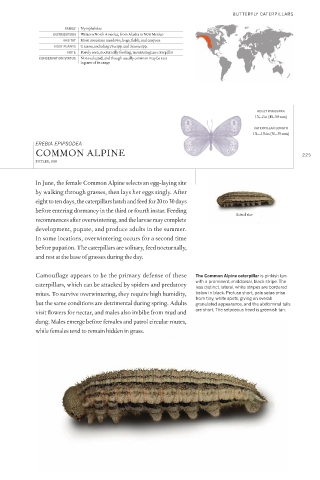
            Camouflage appears to be the primary defense of these   The Common Alpine caterpillar is pinkish tan
            caterpillars, which can be attacked by spiders and predatory   with a prominent, middorsal, black stripe. The
                                                               less distinct, lateral, white stripes are bordered
            mites. To survive overwintering, they require high humidity,   below in black. Profuse short, pale setae arise
            but the same conditions are detrimental during spring. Adults   from tiny, white spots, giving an overall
                                                               granulated appearance, and the abdominal tails
            visit  owers for nectar, and males also imbibe from mud and   are short. The setaceous head is greenish tan.

            dung. Males emerge before females and patrol circular routes,
            while females tend to remain hidden in grass.

