


Page 224 - The Book of Caterpillars: A Life-Size Guide to Six Hundred Species From Around the World
P. 224
BUTTERFLY CATERPILLARS

                                                     FAMILY  Nymphalidae
                                                 DISTRIBUTION  India, Southeast Asia
                                                    HABITAT  Wooded areas; also parks, gardens, and plantations
                                                          containing palms
                                                  HOST PLANTS  Palm, including Coconut Palm (Cocos nucifera), Oil Palm (Elaeis

                                                          guineensis), Yellow Butter y Palm (Dypsis lutescens), Arenga spp.,
                                                          Calamus spp., and Phoenix spp.
                                                      NOTE  Cryptic horned and tailed caterpillar
                                             CONSERVATION STATUS  Not evaluated, but very common, particularly on cultivated land
                                                          and around ornamental parks and gardens


            ADULT WINGSPAN
           2⅛–2¾ in (55–70 mm)
           CATERPILLAR LENGTH
             1¾ in (45 mm)
                                                                       ELYMNIAS HYPERMNESTRA
                                                             COMMON PALMFLY
    222
                                                                                   (LINNAEUS, 1763)


                                            Common Palmfly caterpillars are crepuscular (feeding at
                                            dawn and dusk). Being long and thin, they blend in well with
                                            the host palm fronds. The round eggs, laid singly, usually
                                            on the underside of leaf blades, hatch in four days and are the


                                            caterpillar’s  rst meal. The larvae develop through  ve instars
                                            over 19 days. Competitive cannibalism has been observed among
                                            these caterpillars as a natural control against overcrowding.
                                            The mature larvae wander and pupate on the underside of a
                                            frond. The pretty chrysalis, suspended from a silken pad, head
                                            downward, is of the same vibrant green as the larva, with red,
                                            yellow, and white highlights. The pupal period lasts seven days.


                                            The Common Palm y is a shade-loving butter y with striking
                                            color on the topsides of its wings, although usually only the
                                            cryptic brown undersides are visible. The caterpillars of many
                                            species in the genus Elymnias feed on palm fronds and share the
                                            common name of palm y.

                      Actual size


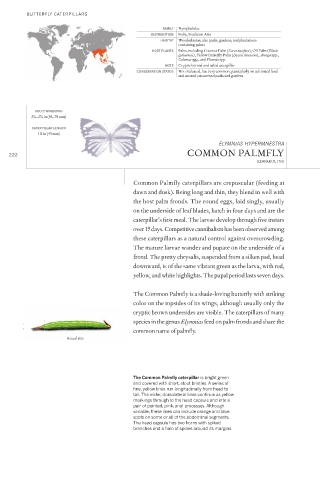
                                            The Common Palm y caterpillar is bright green
                                            and covered with short, stout bristles. A series of
                                              ne, yellow lines run longitudinally from head to
                                            tail. The wider, dorsolateral lines continue as yellow
                                            markings through to the head capsule and into a
                                            pair of pointed, pink, anal processes. Although
                                            variable, these lines can include orange and blue
                                            spots on some or all of the abdominal segments.
                                            The head capsule has two horns with spiked
                                            branches and a halo of spines around its margins.

