


Page 225 - The Book of Caterpillars: A Life-Size Guide to Six Hundred Species From Around the World
P. 225
BUTTERFLY CATERPILLARS

                      FAMILY  Nymphalidae
                  DISTRIBUTION  Nepal, northeast India through to Myanmar, northern Thailand,
                           southern Yunnan (China), and Vietnam
                     HABITAT  Forests and human habitations around host plant plantations
                  HOST PLANTS  Banana (Musa spp.) and palms (Arecaceae)
                      NOTE  Caterpillar whose food—bananas or palm leaves—determines
                           its color
             CONSERVATION STATUS  Not evaluated, but common within its fairly limited range


                                                                                   ADULT WINGSPAN
                                                                                  2⅜–3⅛ in (60–80 mm)
                                                                                  CATERPILLAR LENGTH
                                                                                    1 ⁄   in (40 mm)
            ELYMNIAS MALELAS
            SPOTTED PALMFLY                                                                      223

            (HEWITSON, 1863)


            Although the immature stages of the Spotted Palm y are yet

            to be scienti cally described, the appearance and development
            of the larvae are likely to be similar to those of other Elymnias
            species. However, while many related larvae are exclusively
            palmivorous, E. malelas is an exception as banana leaves are an
            alternative food source. Consequently, larvae raised on banana
            leaves are yellow to match the leaf midrib on which they rest
            when not feeding at the leaf margins. Finding a caterpillar on a
            banana within its species range is therefore a strong indication of

            its identity. Di erentiating species on palms, where a green base
            color predominates, requires closer examination of anatomical

            di erences such as subtle head capsule features.


            The male Spotted Palm y has a strong purple iridescence on
            the topside of the forewings, which is present but reduced in the
            female and accompanied by more widespread white markings.
            The adult males and females mimic the similarly dimorphic
            genders of the Euploea mulciber species, which are known to be   Actual size
            unpalatable to birds.


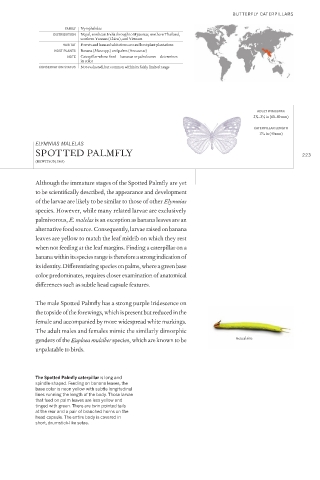
            The Spotted Palm y caterpillar is long and
            spindle-shaped. Feeding on banana leaves, the
            base color is neon yellow with subtle longitudinal
            lines running the length of the body. Those larvae
            that feed on palm leaves are less yellow and
            tinged with green. There are twin pointed tails
            at the rear and a pair of branched horns on the
            head capsule. The entire body is covered in
            short, drumstick-like setae.

