


Page 223 - The Book of Caterpillars: A Life-Size Guide to Six Hundred Species From Around the World
P. 223
BUTTERFLY CATERPILLARS

                      FAMILY  Nymphalidae
                  DISTRIBUTION  United States (Florida, Texas), Mexico, the Caribbean, Ecuador,
                           Peru, Brazil, and Bolivia

                     HABITAT  Forest and woodland clearings and paths, and nearby  elds
                  HOST PLANTS  Passion vine (Passi  ora spp.)
                      NOTE  Long-spined, horned, multicolored caterpillar that can defoliate
                           passion vines
             CONSERVATION STATUS  Not evaluated, but common


                                                                                   ADULT WINGSPAN
                                                                                  3⅛–3½ in (80–90 mm)
                                                                                  CATERPILLAR LENGTH
                                                                                  1 ⁄  –1¾ in (40–45 mm)
            DRYAS IULIA
            JULIA BUTTERFLY                                                                      221

            (FABRICIUS, 1775)


            Julia Butter y caterpillars hatch from eggs that are intially bu
            yellow when laid singly on the tendrils of passion vines, but
            become mottled just before the larvae emerge. The caterpillars,
            which develop through  ve instars, consume host plant leaves

            and utilize withered sections of leaves as resting perches. The
            larvae are unpalatable to birds and lizards because they contain
            varying amounts of cyanogenic glycosides, sequestered from the
            passion vine host plants. They are also protected by their many
            long spines and so feed openly.


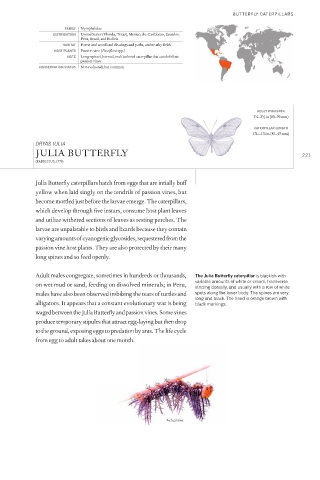
            Adult males congregate, sometimes in hundreds or thousands,   The Julia Butter y caterpillar is blackish with

            on wet mud or sand, feeding on dissolved minerals; in Peru,   variable amounts of white or cream, transverse
                                                               striping dorsally, and usually with a row of white
            males have also been observed imbibing the tears of turtles and   spots along the lower body. The spines are very
            alligators. It appears that a constant evolutionary war is being   long and black. The head is orange brown with
                                                               black markings.
            waged between the Julia Butter y and passion vines. Some vines

            produce temporary stipules that attract egg-laying but then drop
            to the ground, exposing eggs to predation by ants. The life cycle
            from egg to adult takes about one month.


                                                      Actual size

