


Page 229 - The Book of Caterpillars: A Life-Size Guide to Six Hundred Species From Around the World
P. 229
BUTTERFLY CATERPILLARS

                      FAMILY  Nymphalidae
                  DISTRIBUTION  Western North America, from British Columbia to Washington
                           State, Idaho, Oregon, Nevada, and California
                     HABITAT  Mountains, foothills, upper shrub-steppe, open forests, meadows,
                           and roadsides
                  HOST PLANTS  Common Snowberry (Symphoricarpos albus), Shrubby Penstemon
                           (Penstemon fruticosus), Common Mullein (Verbascum thapsus),
                           honeysuckle (Lonicera spp.), and Indian paintbrush (Castilleja spp.)
                      NOTE  Caterpillar that adapts to conditions, prolonging or shortening
                           its development
             CONSERVATION STATUS  Not evaluated, but common in many locations


                                                                                   ADULT WINGSPAN
                                                                                  2–2⅛ in (50–55 mm)
                                                                                  CATERPILLAR LENGTH


                                                                                  1 ⁄  –1⅜ in (30–35 mm)
            EUPHYDRYAS COLON
            SNOWBERRY CHECKERSPOT                                                                227
            (W. H. EDWARDS, 1881)


            Snowberry Checkerspot females lay batches of 50 to 200 eggs on

            host plant leaves in June, which hatch into  rst instar caterpillars
            within two weeks. The first three instars are gregarious,
            consuming leaves in messy silk nests, and expanding or moving
            nests when the food supply is exhausted. The caterpillars
            overwinter in the second or third instar, often in nests on upper
            parts of the host plant. They recommence feeding in spring,
            but if food is in short supply or of poor quality they will reenter
            dormancy. In challenging conditions, caterpillars may pass      Actual size
            through up to seven instars before pupation.
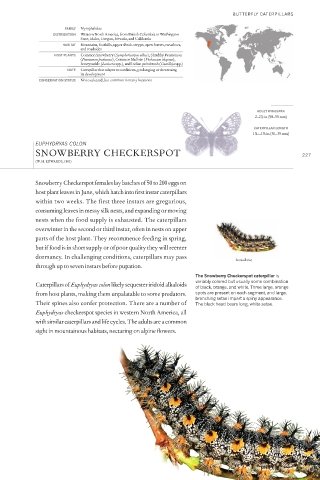
                                                               The Snowberry Checkerspot caterpillar is
            Caterpillars of Euphydryas colon likely sequester iridoid alkaloids   variably colored but usually some combination
                                                               of black, orange, and white. Three large, orange
            from host plants, making them unpalatable to some predators.   spots are present on each segment, and large,
            Their spines also confer protection. There are a number of   branching setae impart a spiny appearance.
                                                               The black head bears long, white setae.
            Euphydryas checkerspot species in western North America, all
            with similar caterpillars and life cycles. The adults are a common
            sight in mountainous habitats, nectaring on alpine  owers.

