


Page 231 - The Book of Caterpillars: A Life-Size Guide to Six Hundred Species From Around the World
P. 231
BUTTERFLY CATERPILLARS

                      FAMILY  Nymphalidae
                  DISTRIBUTION  Southern India to southern China, Chinese Taipei,
                           and Southeast Asia, including the Philippines
                     HABITAT  Open forests, and often seen in urban environments due to
                           ornamental uses of host plants
                  HOST PLANTS  Fig (Ficus spp.), Oleander (Nerium oleander), Gymnanthera spp.,
                           Oxystelma spp., Toxocarpus spp., and Aristolochia spp.
                      NOTE  Caterpillars that cut their food before eating it
             CONSERVATION STATUS  Not evaluated, but not uncommon


                                                                                   ADULT WINGSPAN
                                                                                  3⅛–3½ in (80–90 mm)
                                                                                  CATERPILLAR LENGTH
                                                                                  1¾–2 in (45–50 mm)
            EUPLOEA MULCIBER
            STRIPED BLUE CROW                                                                    229

            (CRAMER, 1777)


            The yellow eggs of the Striped Blue Crow are laid singly
            on the underside of leaves on a range of host plants and

            become the caterpillar’s  rst meal when it hatches. The larvae

            develop through  ve instars over 14 days. Most of the growth
            occurs during the final, longest instar, when the caterpillar
            doubles in size. Curiously, it feeds by  rst disconnecting the

            leaf at its stalk or midrib and securing it in place with silk before
            consuming the severed portion. Early instars feed on younger
            leaves, while older instars eat more mature foliage.


            The caterpillar pupates on the underside of a leaf, spinning a silk
            pad on the midrib, from which the chrysalis is suspended. The
            chrysalis changes color from orange brown to mirrored silver
            to black during the week-long pupation. The adult Striped Blue

            Crow, most commonly seen feeding at  owers, is known to be

            distasteful to predators and is mimicked by other butter ies and
            moths as an evolved defensive strategy.


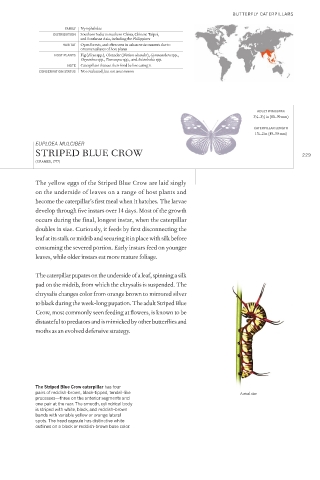
            The Striped Blue Crow caterpillar has four
            pairs of reddish-brown, black-tipped, tendril-like                Actual size
            processes—three on the anterior segments and
            one pair at the rear. The smooth, cylindrical body
            is striped with white, black, and reddish-brown
            bands with variable yellow or orange lateral
            spots. The head capsule has distinctive white
            outlines on a black or reddish-brown base color.

