


Page 226 - The Book of Caterpillars: A Life-Size Guide to Six Hundred Species From Around the World
P. 226
BUTTERFLY CATERPILLARS

                                                     FAMILY  Nymphalidae
                                                 DISTRIBUTION  Mountainous regions of northwest Europe, across central Europe
                                                          to the Urals, southern Siberia, Mongolia, and northeastern China
                                                    HABITAT  Forest margins and clearings, and damp grasslands up to
                                                          7,875 ft (2,400 m) elevation
                                                  HOST PLANTS  Grasses, particularly Agrostis spp., Dactylis spp., and Poa spp.
                                                      NOTE  Striped, brown caterpillar of upland grassland and forest margins
                                             CONSERVATION STATUS  Not evaluated


            ADULT WINGSPAN
             1¾ in (45 mm)
           CATERPILLAR LENGTH
             1 in (25 mm)
                                                                              EREBIA AETHIOPS
                                                                  SCOTCH ARGUS
    224
                                                                                     (ESPER, 1777)


                                            The female Scotch Argus lays her spherical egg singly on short
                                            grass leaves and seed heads. The caterpillar is slow growing,
                                            often feeding at night and resting near the base of the grass
                                            during the day. If disturbed, it falls to the ground and “plays
                       Actual size
                                            dead.” The young caterpillar overwinters in leaf litter near the
                                            base of the food plant and becomes active again the following
                                            April. Mature larvae move to the ground to pupate in a loose
                                            cocoon near the base of the food plant, often in moss and lichen.


                                            There is one generation a year, with the adults flying late
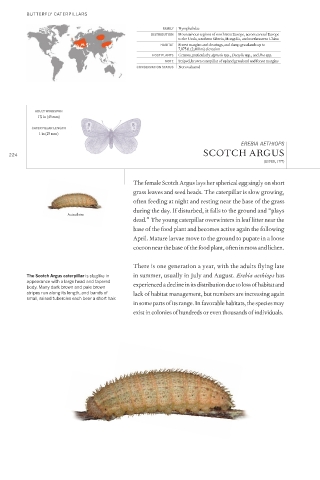
          The Scotch Argus caterpillar is sluglike in   in summer, usually in July and August. Erebia aethiops has
          appearance with a large head and tapered   experienced a decline in its distribution due to loss of habitat and
          body. Many dark brown and pale brown
          stripes run along its length, and bands of   lack of habitat management, but numbers are increasing again
          small, raised tubercles each bear a short hair.
                                            in some parts of its range. In favorable habitats, the species may
                                            exist in colonies of hundreds or even thousands of individuals.

