


Page 222 - The Book of Caterpillars: A Life-Size Guide to Six Hundred Species From Around the World
P. 222
BUTTERFLY CATERPILLARS

                                                     FAMILY  Nymphalidae
                                                 DISTRIBUTION  India, Sri Lanka, much of Southeast Asia, the Philippines,
                                                          Papua New Guinea, northeast Australia, and adjacent

                                                          southwest Paci c Islands
                                                    HABITAT  Lowland rain forests and adjacent areas
                                                  HOST PLANTS  Chinese Violet (Asystasia gangetica) and Pseuderanthemum spp.
                                                      NOTE  Aggressive and voracious caterpillar
                                             CONSERVATION STATUS  Not evaluated, but common


            ADULT WINGSPAN
           2 ⁄  –2 ⁄   in (62–65 mm)
           CATERPILLAR LENGTH
           2⅛–2⅜ in (55–60 mm)
                                                                        DOLESCHALLIA BISALTIDE
                                                                          LEAFWING
    220
                                                                                   (CRAMER, [1777])


                                            The Leafwing caterpillar, also known as the Autumn Leaf,
                                            occurs singly or in small numbers often on the widespread
                                            weed Chinese Violet, which in some parts of its range is the
                                            host plant of choice. It is a nocturnal feeder on young plants or
                                            regrowth on more mature plants, hiding by day in ground litter
                                            or under stones near the base of the food plant. The caterpillar
                                            is very active and can move rapidly. It can strip small plants and
                                            sometimes cannibalizes young caterpillars. Initially pale yellow

                                            in color, the caterpillar develops through  ve instars in as little
                                            as 12 days, though over a longer period in cooler conditions.


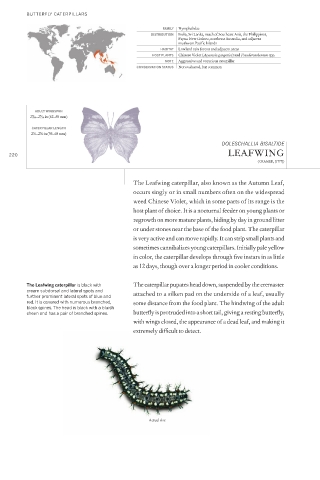
          The Leafwing caterpillar is black with   The caterpillar pupates head down, suspended by the cremaster
          cream subdorsal and lateral spots and   attached to a silken pad on the underside of a leaf, usually
          further prominent lateral spots of blue and
          red. It is covered with numerous branched,   some distance from the food plant. The hindwing of the adult
          black spines. The head is black with a bluish


          sheen and has a pair of branched spines.   butter y is protruded into a short tail, giving a resting butter y,
                                            with wings closed, the appearance of a dead leaf, and making it
                                            extremely di cult to detect.


                                                Actual size

