


Page 230 - The Book of Caterpillars: A Life-Size Guide to Six Hundred Species From Around the World
P. 230
BUTTERFLY CATERPILLARS

                                                     FAMILY  Nymphalidae
                                                 DISTRIBUTION  India, Sri Lanka, southern China, Sumatra, Java, Bali,
                                                          and northern and eastern Australia
                                                    HABITAT  Open forests and woodlands, riparian areas, gullies, and gardens

                                                  HOST PLANTS  Wide range in Asclepiadaceae (milkweeds), Moraceae ( gs),
                                                          and Apocynaceae (dogbanes)
                                                      NOTE  Smooth-bodied, vividly colored caterpillar that has ornate tentacles
                                             CONSERVATION STATUS  Least concern and common in its range


            ADULT WINGSPAN
           2¾–3 in (70–75 mm)
           CATERPILLAR LENGTH
           1¾–2⅛ in (45–55 mm)
                                                                                EUPLOEA CORE
                                                                 COMMON CROW
    228
                                                                                    (CRAMER, 1780)


                                            Common Crow caterpillars hatch from eggs laid singly on the
                                            undersides of young leaves and  owers of host plants. The larvae

                                            feed on soft new growth and usually pupate on the underside of
                                            a leaf or some other part of the host plant. Larval development
                                            varies in duration from three to ten weeks, according to host
                                            plant species, temperature, and the seasonal quality of new
                                            shoots. Caterpillar survival rates are poor at temperatures below
                                            about 68°F (20°C).


                                            The caterpillars feed on generally poisonous plants and have
                                            evolved feeding strategies to minimize exposure to such
                                            toxins, while using some of them for defense. For example,
                                            if disturbed, the larvae will exude  uid containing toxins from the

                                            mouth to deter a predator. Adults form large, nonreproductive
                                            aggregations during the dry season in sheltered habitats, often

                                            near creeks. Occasionally, migratory  ights will occur, usually
                                            to more humid areas. Many subspecies occur throughout the
                                            Common Crow’s range.


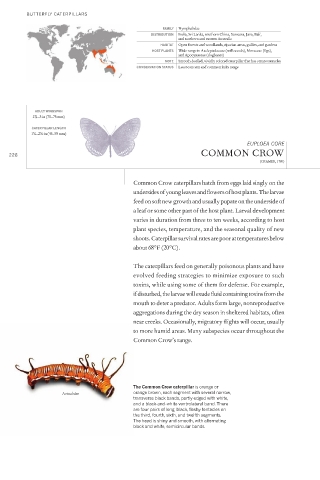
                                            The Common Crow caterpillar is orange or
                     Actual size            orange brown, each segment with several narrow,
                                            transverse black bands, partly edged with white,
                                            and a black-and-white ventrolateral band. There
                                            are four pairs of long, black,   eshy tentacles on
                                            the third, fourth, sixth, and twelfth segments.
                                            The head is shiny and smooth, with alternating
                                            black and white, semicircular bands.

