


Page 234 - The Book of Caterpillars: A Life-Size Guide to Six Hundred Species From Around the World
P. 234
BUTTERFLY CATERPILLARS

                                                     FAMILY  Nymphalidae
                                                 DISTRIBUTION
                                                   TRIBUTION
                                                 DISTRIBUTION  North and South America, from southern United States and the
                                                 DIS
                                                          Caribbean south to northern Peru
                                                    HABITAT
                                                    HABITAT T  Forests and meadows, including disturbed habitats
                                                    HABIT
                                                       A
                                                  HOST PLANTS
                                                  HOS
                                                  HOST PLANTS S  Passion vine (Passi  ora spp.)
                                                    T PLANT
                                                      NO
                                                      NOTE  Spiny caterpillar that is unpalatable
                                                       TE
                                                      NOTE
                                                     T
                                                      A
                                             CONSERV
                                                  TION S
                                                 A
                                                      TUS
                                             CONSERVATION STATUS
                                             CONSERVATION STATUS  Not evaluated, but common
            ADULT WINGSPAN
            2–4 in (50–100 mm)
           CATERPILLAR LENGTH
           1    –2 in (40–50 mm)
                                                                       HELICONIUS CHARITHONIA
                                                             ZEBRA LONGWING
    232
                                                                                   (LINNAEUS, 1767)
                                            Zebra Longwing caterpillars are found on the stems or underside
                                            of leaves of various species of passion vine. The plants are
                                            toxic, so ingesting them makes the larvae distasteful, providing
                                            a chemical defense against predators. Their conspicuous,
                                            contrasting black-and-white patterning advertises their
                                            unpalatable taste. Additionally, the caterpillars are protected by

                                            sharp, black spines. There are thought to be  ve larval instars,
                                            and development from egg to adult takes around a month.


                                            Pupation occurs on or near the host plant, and the pupae are
                                            visited by Zebra Longwing males. They frequently sit on the
                                            pupae, competing with each other to insert their abdomen and

                                            mate before a female butter y ecloses; pheromones determine
                                            the adult’s sex at later stages of pupal development. Mated
                                            females then disperse long distances to lay eggs on as many
                                            passion vines as possible. Like all Heliconius species, Zebra
                                            Longwing adults feed not only on nectar but also on pollen,
                                            which allows them to live longer than other butter ies.


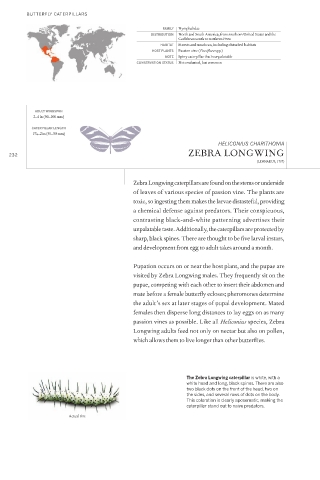
                                                             The Zebra Longwing caterpillar is white, with a
                                                             white head and long, black spines. There are also
                                                             two black dots on the front of the head, two on
                                                             the sides, and several rows of dots on the body.
                                                             This coloration is clearly aposematic, making the
                                                             caterpillar stand out to naive predators.
                       Actual size

