


Page 233 - The Book of Caterpillars: A Life-Size Guide to Six Hundred Species From Around the World
P. 233
BUTTERFLY CATERPILLARS

                      FAMILY  Nymphalidae
                  DISTRIBUTION  Southeastern Mexico, south to the Amazon basin, including
                           Trinidad, as far south as southeastern Peru and northern Bolivia
                     HABITAT  Forest borders and secondary growth of humid and semi-humid
                           tropical forests, usually below 3,600 ft (1,100 m) elevation
                  HOST PLANTS  Croton spp.
                      NOTE  Intricately patterned caterpillar that hides within rolled leaves
             CONSERVATION STATUS  Not evaluated, but not considered threatened


                                                                                   ADULT WINGSPAN
                                                                                  2–2⅛ in (50–55 mm)
                                                                                  CATERPILLAR LENGTH
                                                                                  1¾–2⅛ in (45–55 mm)
            FOUNTAINEA RYPHEA
            FLAMINGO LEAFWING                                                                    231

            (CRAMER, [1775])


            Flamingo Leafwing caterpillars hatch from almost perfectly
            round, smooth, and yellowish-white eggs, which are laid singly
            on the underside of leaves. Like other, related species, early
            instars build and rest upon small lines of their own frass that
            are silked into chains extending from the margins of their host
            plant leaves. As they grow, the larvae switch to living within a
            tubular shelter, which they build by curling up one of the leaves,
            usually remaining inside almost constantly, reaching out to feed
            on nearby leaf tissue or on the leaf material of the shelter itself.

            The larvae may pupate on or o  their host plant, hanging their
            emerald green and yellow-edged pupa from a thin branch or
            the bottom of a leaf.
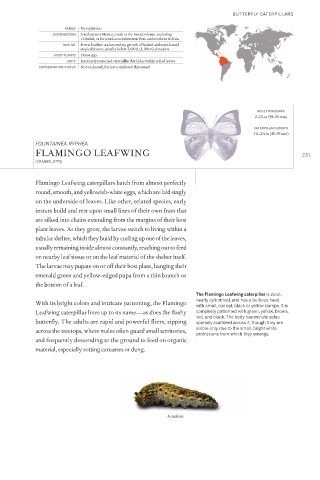
                                                                The Flamingo Leafwing caterpillar is stout,
            With its bright colors and intricate patterning, the Flamingo   nearly cylindrical, and has a bulbous head
                                                                with small, conical, black or yellow bumps. It is
            Leafwing caterpillar lives up to its name—as does the  ashy   complexly patterned with green, yellow, brown,

            butterfly. The adults are rapid and powerful fliers, zipping   red, and black. The body has minute setae
                                                                sparsely scattered across it, though they are
            across the treetops, where males often guard small territories,   visible only due to the small, bright white
                                                                protrusions from which they emerge.
            and frequently descending to the ground to feed on organic
            material, especially rotting carcasses or dung.


                                                      Actual size

