


Page 235 - The Book of Caterpillars: A Life-Size Guide to Six Hundred Species From Around the World
P. 235
BUTTERFLY CATERPILLARS

                      FAMILY  Nymphalidae
                  DISTRIBUTION  The Andes, from southern Colombia to Bolivia
                     HABITAT  Humid and semi-humid cloud forests and forest borders at
                           2,625–6,600 ft (800–2000 m) elevation
                  HOST PLANTS  Passion vine (Passi  ora spp.)
                      NOTE  Caterpillar whose natural history, however, is little known
             CONSERVATION STATUS  Not evaluated, but not considered threatened


                                                                                   ADULT WINGSPAN
                                                                                  3 ⁄  –3
⁄   in (78–84 mm)
                                                                                  CATERPILLAR LENGTH
                                                                                  2⅛–2⅜ in (55–60 mm)
            HELICONIUS TELESIPHE
            TELESIPHE LONGWING                                                                   233

            (DOUBLEDAY, 1847)


            The Telesiphe Longwing caterpillar hatches from an egg laid
            singly on the newly opening leaves or young tendrils of the
            host plant; the female may, however, return multiple times to
            the same plant, leaving behind several eggs. First instar larvae
            consume most of their eggshell before beginning to feed on
            nearby leaf tissue. While the caterpillars are generally solitary at
            all instars, the adults sometimes gather in small groups to spend
            the night hanging together in loose clusters from the tip of a thin
            branch or vine. Prior to eclosion of a female pupa, males will also
            congregate in the area, vying for the chance to copulate with the
            newly emerged female.


            While ovipositing, the fluttery, hovering flight of Telesiphe
            Longwing females is distinctive, and watching for this
            characteristic behavior is often the best way to  nd host plants

            and caterpillars. With their paired, facial, black spots on the front
            of the head, the black-spotted larvae are typical of other, related
            species of Heliconius caterpillars, all of which also feed on
            Passi  ora plants.


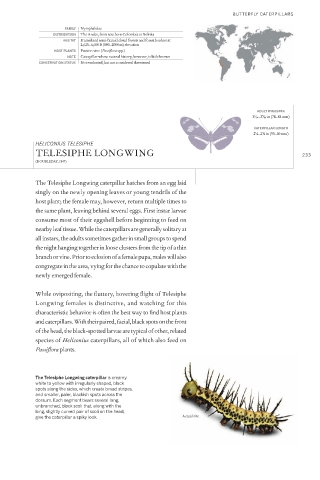
            The Telesiphe Longwing caterpillar is creamy
            white to yellow with irregularly shaped, black
            spots along the sides, which create broad stripes,
            and smaller, paler, blackish spots across the
            dorsum. Each segment bears several long,
            unbranched, black scoli that, along with the
            long, slightly curved pair of scoli on the head,
            give the caterpillar a spiky look.             Actual size

