


Page 236 - The Book of Caterpillars: A Life-Size Guide to Six Hundred Species From Around the World
P. 236
BUTTERFLY CATERPILLARS

                                                     FAMILY  Nymphalidae
                                                 DISTRIBUTION  Southeastern and southern Australia
                                                    HABITAT  Woodlands and eucalypt forests with grassy understory, from
                                                          alpine to semi-arid and urban environments
                                                  HOST PLANTS  Native and introduced grasses, including Cynodon spp., Poa spp.,
                                                          Themeda spp., Microlaena spp., Bromus spp., and Ehrharta spp.
                                                      NOTE  Long-lived caterpillar that develops in the cooler months
                                             CONSERVATION STATUS  Least concern, and common in southern areas of its range


            ADULT WINGSPAN
           2 ⁄  –2½ in (56–64 mm)
           CATERPILLAR LENGTH
             1 ⁄   in (36 mm)
                                                                        HETERONYMPHA MEROPE
                                                               COMMON BROWN
    234
                                                                                   (FABRICIUS, 1775)


                                            Hatching of Common Brown caterpillars is timed to coincide
                                            with the start of the fall and winter rains, which produces soft
                                            growth of the grasses. The caterpillars occur singly or in small
                                            groups on a range of grasses. The larvae feed at night on the
                                            leaf blades and hide under litter during the day. Caterpillar
                                            development takes five to six months and is slow during the
                                            cooler months with rapid growth in the spring.


                                            Pupation occurs in early spring, the pupae lying loose on the
                                            ground. This sexually dimorphic species flies low in grassy
                                            areas, and males will hilltop. Males emerge in the spring before
                                            females, with mating occurring in the spring. Females become
                                            dormant, unless disturbed, during the hot, dry summer, while
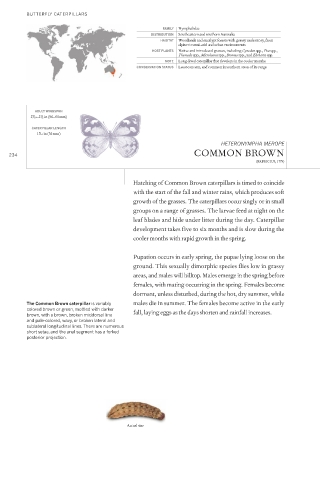
          The Common Brown caterpillar is variably   males die in summer. The females become active in the early
          colored brown or green, mottled with darker   fall, laying eggs as the days shorten and rainfall increases.
          brown, with a brown, broken middorsal line
          and pale-colored, wavy, or broken lateral and
          sublateral longitudinal lines. There are numerous
          short setae, and the anal segment has a forked
          posterior projection.


                                          Actual size

