


Page 237 - The Book of Caterpillars: A Life-Size Guide to Six Hundred Species From Around the World
P. 237
BUTTERFLY CATERPILLARS

                      FAMILY  Nymphalidae
                  DISTRIBUTION  Southern United States, south through Mexico, Central America,
                           and some Caribbean islands, and South America to northern
                           Argentina and Uruguay
                     HABITAT  Humid lowland and foothill forests
                  HOST PLANTS  Cecropia spp.
                      NOTE  Distinctive, large, spiky caterpillar whose pupa wriggles
                           if disturbed
             CONSERVATION STATUS  Not evaluated, but not likely to become endangered


                                                                                   ADULT WINGSPAN
                                                                                 4¼–4⅝ in (110–120 mm)
                                                                                  CATERPILLAR LENGTH
                                                                                 2¾–2  ⁄   in (70–72 mm)
            HISTORIS ODIUS
            STINKY LEAFWING                                                                      235

            (FABRICIUS, 1775)


            Early instar Stinky Leafwing larvae make frass chains at the
            margins of their host plant leaf, presumably to avoid the stinging
            ants that often reside within the stems of Cecropia trees. Larger
            larvae rest along the terminal meristem and are apparently not
            bothered by the ants. If touched, the large, dead-leaf colored
            pupa wriggles vigorously about, like a  sh out of water. This

            behavior has led to the local name of pescadillo, meaning “little

             sh,” in some areas of Costa Rica.

            Like the adults of the only other member of the genus, Historis

            acheronta, adult Stinky Leafwings are extremely powerful  yers
            and spend most of their time in the forest canopy feeding on
            overripe and damaged fruit. They are, however, familiar to
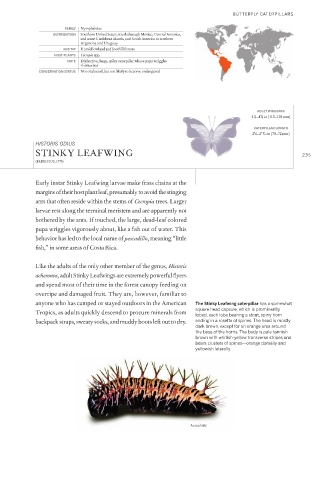
            anyone who has camped or stayed outdoors in the American   The Stinky Leafwing caterpillar has a somewhat
            Tropics, as adults quickly descend to procure minerals from   square head capsule, which is prominently
                                                               lobed, each lobe bearing a stout, spiny horn
            backpack straps, sweaty socks, and muddy boots left out to dry.  ending in a rosette of spines. The head is mostly
                                                               dark brown, except for an orange area around
                                                               the base of the horns. The body is pale tannish
                                                               brown with whitish-yellow transverse stripes and
                                                               bears clusters of spines—orange dorsally and
                                                               yellowish laterally.


                                                              Actual size

