


Page 238 - The Book of Caterpillars: A Life-Size Guide to Six Hundred Species From Around the World
P. 238
BUTTERFLY CATERPILLARS

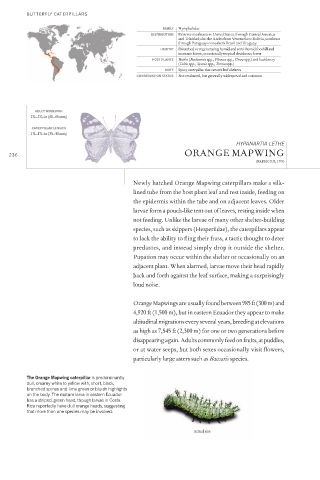
                                                     FAMILY  Nymphalidae
                                                 DISTRIBUTION  Extreme southeastern United States, through Central America
                                                          and Trinidad; also the Andes from Venezuela to Bolivia, southeast
                                                          through Paraguay to southern Brazil and Uruguay
                                                    HABITAT  Disturbed or regenerating humid and semi-humid foothill and
                                                          montane forest, occasionally tropical deciduous forest
                                                  HOST PLANTS  Nettle (Boehmeria spp., Phenax spp., Urera spp.) and hackberry
                                                          (Celtis spp., Sponia spp., Trema spp.)
                                                      NOTE  Spiny caterpillar that creates leaf shelters
                                             CONSERVATION STATUS  Not evaluated, but generally widespread and common


            ADULT WINGSPAN
           2⅜–2 ⁄   in (60–65 mm)
           CATERPILLAR LENGTH
           1⅜–1 ⁄   in (35–40 mm)


                                                                            HYPANARTIA LETHE
                                                            ORANGE MAPWING
    236
                                                                                   (FABRICIUS, 1793)


                                            Newly hatched Orange Mapwing caterpillars make a silk-
                                            lined tube from the host plant leaf and rest inside, feeding on
                                            the epidermis within the tube and on adjacent leaves. Older
                                            larvae form a pouch-like tent out of leaves, resting inside when
                                            not feeding. Unlike the larvae of many other shelter-building
                                            species, such as skippers (Hesperiidae), the caterpillars appear
                                            to lack the ability to   ing their frass, a tactic thought to deter
                                            predators, and instead simply drop it outside the shelter.
                                            Pupation may occur within the shelter or occasionally on an
                                            adjacent plant. When alarmed, larvae move their head rapidly
                                            back and forth against the leaf surface, making a surprisingly
                                            loud noise.


                                            Orange Mapwings are usually found between 985 ft (300 m) and
                                            4,920 ft (1,500 m), but in eastern Ecuador they appear to make
                                            altitudinal migrations every several years, breeding at elevations
                                            as high as 7,545 ft (2,300 m) for one or two generations before
                                            disappearing again. Adults commonly feed on fruits, at puddles,
                                            or at water seeps, but both sexes occasionally visit flowers,
                                            particularly large asters such as Baccaris species.


          The Orange Mapwing caterpillar is predominantly
          dull, creamy white to yellow with, short, black,
          branched spines and lime green or bluish highlights
          on the body. The mature larva in eastern Ecuador
          has a striped, green head, though larvae in Costa
          Rica reportedly have dull orange heads, suggesting
          that more than one species may be involved.

                                                               Actual size

