


Page 240 - The Book of Caterpillars: A Life-Size Guide to Six Hundred Species From Around the World
P. 240
BUTTERFLY CATERPILLARS

                                                     FAMILY  Nymphalidae
                                                   TRIBUTION
                                                 DISTRIBUTION  Northeastern and eastern Australia
                                                 DISTRIBUTION
                                                 DIS
                                                    HABITAT
                                                    HABITAT
                                                    HABIT A T  Tall, open forests and the margins of rain forests
                                                  HOST PLANTS
                                                  HOS
                                                    T PLANT
                                                  HOST PLANTS S  Tropical and temperate grass species in the Poaceae family
                                                      NOTE  Nocturnal, long-lived, cryptic caterpillar
                                                       TE
                                                      NO
                                                      NOTE
                                             CONSERV A TION S T A TUS  Not evaluated, but locally common
                                             CONSERVATION STATUS
                                             CONSERVATION STATUS
            ADULT WINGSPAN
             1 ⁄   in (30 mm)
           CATERPILLAR LENGTH
             ⅞ in (22 mm)
                                                                           HYPOCYSTA METIRIUS
                                                               BROWN RINGLET
    238
                                                                                     BUTLER, 1875


                                            The Brown Ringlet caterpillar feeds nocturnally on grass,
                                            resting at the base of a tuft during the day, although early instars
                                            stay on the leaf on which they are feeding. Young caterpillars
                                            feed down the leaf blade but only across to the midvein, forming
                                            scars down one side of the leaf. Mature caterpillars consume the
                                            full leaf as they move down toward the base. The larvae feed and
                                            complete development over a period of between  ve weeks and

                                            six months, depending on the location of the population and the
                                            time of year. In the warmer northern areas, caterpillars are found
                                            throughout the year.


                                            The caterpillar pupates on a grass stem, the angular brown pupa
                                            resembling a small, curled, dead leaf hanging from the stem.


                                            The adult butter ies are weak  iers and  y close to the ground,
                                            although males will often  y to hilltops. The genus contains 12

                                            species restricted to Australia, New Guinea, and the Aru Islands.

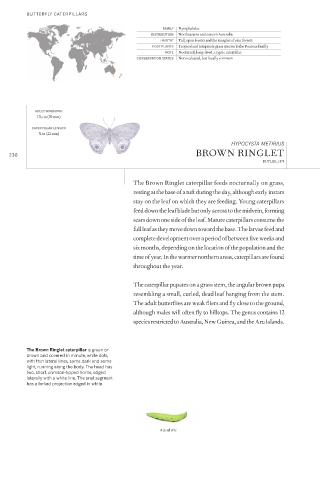
          The Brown Ringlet caterpillar is green or
          brown and covered in minute, white dots,
          with thin lateral lines, some dark and some
          light, running along the body. The head has
          two, short, crimson-tipped horns, edged
          laterally with a white line. The anal segment
          has a forked projection edged in white.


                                                    Actual size

